5th Sunday in Easter
Year A Readings
Acts 7:55-60, Psalm 31:1-5, 15-16, 1 Peter 2:2-10
+ John 14:1-14
The Collect
Almighty God, whom truly to know is everlasting life: Grant us so perfectly to know your Son Jesus Christ to be the way, the truth, and the life, that we may steadfastly follow his steps in the way that leads to eternal life; through Jesus Christ your Son our Lord, who lives and reigns with you, in the unity of the Holy Spirit, one God, for ever and ever. Amen.
The Homily
If I had a nickel for every time I’ve been asked if my church was a “Bible-based church” why… I could buy you all lunch. I’ve always experienced irritation with that question, because what the question implies is that there’s only one way to read the Bible. But I feel differently. I think that for a community of people to base their fellowship and work on the Christian scriptures, must mean that Jesus of Nazareth has a special place in people’s heart, both as the Messiah and as the interpretive principle for the whole Bible. That means when Paul says that women shouldn’t speak or lead, he’s wrong, because Jesus commissioned Mary Magdalene as the first Apostle of the Resurrection. That means that you don’t have to be Christian to be loved by God, because Jesus loved everyone kind of person the same.
Has it ever bothered any of you, for instance, to think that all those billions of people who never heard of Jesus were just going to go to hell? It’s always bothered me. Today we have a chance together to think it through, and I hope you’ll find in this little speech that not only is the condemnation of other faiths unethical, it also misses the point altogether of what Jesus teaches us about his being the Way the Truth and the Life. A church obsessed with control assumes this teaching of Jesus is about correct belief. But the context of the passage makes clear that this interpretation is dead wrong. Following the washing of the disciples’ feet, this teaching of Jesus has to do with our way of being in the world.
Let us pray: Most gracious God, out of all the words that will now be spoken and heard, may it be your Living Word that stays in our hearts. Give us the grace to receive it, and give us the charity to let all the other words slip away. We ask this in the Name of Jesus Christ. Amen.
In today’s Gospel lesson, we hear these famous words: “I am the way, the truth, and the life. No one comes to the Father except through me.” Famous: Yes. Because, for centuries now, and certainly for the entire history of Christianity in the United States, this scripture has been interpreted to mean that if you believe the right things about Jesus, you’ll go to heaven.
This interpretation arises out of the creedal period of early Christianity spanning roughly 450 years from 325 to 787 A. D. during which the Roman Emperors insisted that Christian leaders get their story straight. The emperors forced the bishops to produce philosophical formulas, articulating the intellectual content of the Faith. The repository of this forceful politics that we still use every week is the Nicene Creed. This casting of the faith into a set of bullet points ruined everything, because it gave the mind precedence over the understanding which comes from experience in life of discipleship. Indeed, from the early Middle Ages on, Christianity has been for the vast majority a matter of the head and not of the heart.
Allow me to share a few examples:
In the early fifth Century, Jerome translated the Greek scriptures into Latin so that everyone could read the Bible. Over the centuries, however, the Western Catholic Church began to believe that the Scriptures should only be read in Latin and everything else was dangerous. So nearly a thousand years later, when John Wycliffe translated the Bible into English, you know… so that everybody could read it, the wise old Church condemned him as a heretic and burned him alive at the stake for doing just want Jerome had done.
And at about that same time in the history of the Western Church, the great Catholic intellectual of the Middle Ages, Thomas Aquinas, merged the Greek philosophy of Aristotle with Christian theology in order to nail down just exactly how ordinary bread and wine can become the actual Body and Blood of Jesus Christ in the Eucharist. Aquinas was very convincing, and from the 13th Century onward, unless one consented to the intellectual premise of transubstantiation one was considered a heretic and, well, you know… burned at the stake for one’s incorrect belief.
Right belief was arbitrated by a few and used with increasingly punitive force as political and economic leverage: you’ve all heard of the Spanish Inquisition, I presume. Well, it only took two-hundred years for that powder keg to blow, but nothing much changed. The Protestant Reformation began in 1517 with an Augustinian Roman Catholic Monk, Martin Luther, beating everyone over the head with the belief that human beings are saved from sin and death and hell by faith alone, and that this faith had to do not with meritorious acts whatsoever, but with the ordering of the mind to accept the message of Jesus’s identity as the Messiah, the Son of God. No matter what you did or didn’t do, it was your belief that mattered. So, you see Luther and Calvin and those other rowdy Reformers changed what was acceptable belief, but not the notion that belief was all that mattered. This terrible mistake, which has no basis in the Gospel, remains rampant to this day, so that all of us have grown up in a religious culture in which intellectual subscription to the principle of Christ is all that matters.
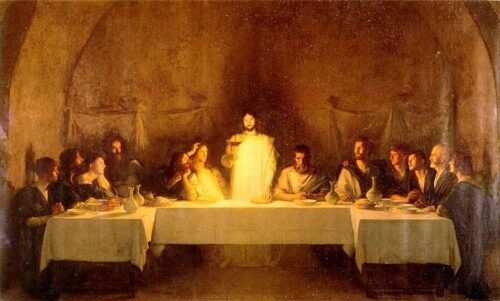
But I’ll be so bold as to say that this whole history shoots very wide of the mark of Jesus’s teaching to his disciples on that Thursday evening when they ate the Passover meal together for the last time: that moment when Jesus washed their feet, told them to love as they’d been loved by him, and said “I am the way, the truth, and the life. No one comes to the Father except through me.”
You see, in the context of the Last Supper, it’s clear that this teaching of Jesus isn’t about the content of anyone’s belief, it’s about the quality of our love. This seems like an easy argument to make, since the disciples all seemed to be pretty much at odds with Jesus about who the Messiah was supposed to be. His disciples believe quite differently than him, but correct belief isn’t the hallmark of discipleship. Correct love was and remains the mark of discipleship: so, Jesus says, “…by this they will know that you are my disciples.” (John 13:35)
Let this move your heart and tell your mind to go sit down.
Jesus, the Incarnate Love, washes the feet of Judas Iscariot and then says: this is the Way—the only Way— to the place where I am going. In other words, loving those who can’t or won’t love you back is the starting point of the Christian Faith, no matter what you believe.
Jesus cares far more about the quality of our love,
than about what we say we believe.
slowly…measure every word
Jesus cares far more about the quality of our love,
than about what we say we believe.
Love is not born of faith.
Faith is born of love. The mind follows the heart, baffled and incredulous.
This means that a faith which is not lived in and through acts of love loses its direct connection to Jesus. It is not what we say we believe that marks us as people of faith; it is what we do that shows who we are and to whom we belong.
One of the great things about continuing to work at moving into my office has been to get my books out of their boxes and talk with my old friends. One of my old friends is the great 20th Century theologian, Karl Barth. In his massive exploration of Christian Faith, Church Dogmatics, he writes about all this in Volume IV, “The Doctrine of Reconciliation.”[1] As Barth introduces his theology of reconciliation, he sets up some parameters that are actually quite simple to understand:
- We know who God is in Christ because of what God does through Christ: God doesn’t tell us, God shows us;
- Therefore, divine nature and divine action cannot be separated, so that no teaching of Jesus can be interpreted outside his acts as Savior.
- In a similar way, and because of this, we can only know ourselves in our human action.
Allow me to share a little snippet of Barth’s great genius. He writes:
Our starting point is that this “God with us” at the heart of the Christian message is the description of an act of God, or better, [the phrase “God with us” describes] God himself in this act of His. [The phrase “God with us”] is a report… It is not [an arbitrary state of being] but an event…
And [God] is who He is, and lives as what He is, in that He does what He does…
We know about God only if we are witnesses—however distantly and modestly—of His act. And we speak about God only as we do—however deficiently—as those who proclaim His act. [The phrase] “God with us” as it occurs at the heart of the Christian message is the attestation and report of the life and act of God…[2]
Barth goes on to point out that our human being and existence have entirely to do with the nature and identity revealed in our own actions.[3] What this means, quite simply, is that our Christian faith can only be truly known as we take up the works of Christ Jesus, and as Jesus points out, to do even greater works than these. So James says, “…faith by itself, if it has no works, is dead… Show me your faith without works, and I by my works will show you my faith.” (2:17-18). James learned this from the Shepherd who showed his love for the Father by laying down his life for the sheep. (see John 10) The Christian faith, as Barth points out, is the faith of witnesses. And what has been done to and for us shapes how we live in the world. Belief is decidedly secondary to the experience of the Holy Cross and the Empty Tomb.
“I am the Way, the truth, and the life.
No one comes to the Father except through me.”
As this teaching cannot be separated from the Last Supper, neither can it be separated from what follows: the crucifixion and resurrection of Jesus. So let us see clearly that the resurrection of Jesus is the Father’s emphatic rebuttal to every religion that prefers right belief over the Messiah’s call to hold one another in our need. Jesus heals on the Sabbath; they yell “Crucify him!”
To be a Bible-based church then, means to gather as witnesses to God’s rebuttal of the world’s self-gratifying cruelty, that we might continue to discern the call of the Messiah in the power of the Spirit. Being Bible-based does not mean to read the Bible literally; it means to imitate the life of Christ in our own actions. I hope that this realization will help you when you’re asked to give an account of our congregation’s unconditional welcome and ministry.
What then are we to say about these things? Are the billions of people who do not subscribe to our beliefs condemned to an eternity of misery? By no means!
All those, of every tribe and people, who participate in the grace of Christ through lives of humble service will have the identity of Christ revealed to them at the last. And they will certainly not burn in hell because they were born Muslim or Chocktaw or Jewish. By the same token, all who are cruel and pridefully hold others in contempt shall be held accountable by the Lord, no matter what they say they believe.
The Hindu grandmother who loves her neighbor as herself and teaches her children to do so has done what the Messiah commands. And the transgender atheist, who pulls over on the highway to help a family change their flat tire, and goes through with it even after he sees their MAGA bumper sticker: he has done what the Messiah commands. But the die-hard, fundamentalist praise band leader who beats her kids when she drinks has not done what the Messiah commands. She may come to our righteous judge and say “Lord, Lord” but surely the Messiah will keep his own word and say “I never knew you. Go away from me you evildoer.” (Matthew 7:23) Whatever happens then is a mystery, but let us hope than when we are brought to account, the Lord will see that we at least have tried to love the way he did when he walked among us. So, St. Paul teaches the Jews in the Church at Rome:
…it is not the hearers of the law who are righteous in God’s sight, but the doers of the law who will be justified. When Gentiles, who do not possess the law, do instinctively what the law requires, these, though not having the law, are a law unto themselves. They show that what the law requires is written on their hearts, to which their own conscience also bears witness; and their conflicting thoughts will accuse or perhaps excuse them on the day when, according to my gospel, God, through Jesus Christ, will judge the secret thoughts of all. […] Owe no one anything, except to love one another; for the one who loves another has fulfilled the law. (Romans 2:13-16, 13:8)
What we’ve always felt in your bones to be true about God’s love for everyone now has some theological and biblical foundation to stand on. When someone comes at you and calls you a heretic because you don’t believe the right stuff, ask them with great humility about their service to those in need. Ask them about this nation’s cruelty to strangers and their children. Ask them how they feel about Gay couples adopting and fostering unwanted kids. Ask them about the death penalty and the rape of the earth. For the proof of faith in Jesus is in the operation of the love of Jesus: for “God with us”—Emmanuel—is not a name but a history. But ask gently… ask gently… And then, in the quiet of the night, ask yourself about your service to the suffering. And do not let your hearts be troubled, and do not be afraid: for to those who “follow in his steps” …who keep Christ’s commandment to love we’ve been loved, … to these the Spirit will give “grace upon grace.” (John 1: 16)
Christ’s way of welcoming everyone with humility and unconditional love is the path to the Creator.
Imitating his adoration for God through the love of neighbor and stranger and enemy leads us to the recovery of the image of God and the articulation of our true selves; and in this we have life: abundant, eternal, and free.
Be glad in the Good News, beloved in Christ, and choose again this day whom you will serve. Amen.
[1] Barth, Karl. Church Dogmatics, Volume IV, Part 1 (Hendrickson, 2010).
[2] Ibid., pages 6 & 7.
[3] Ibid., page 7.