Holy Saturday
Holy Saturday
4 April A. D. 2026
Readings
Lamentations 3:1-9, 19-24; Psalm 31:1-4, 15-16; 1 Peter 4:1-8
+ John 19:38-42
The Collect
O God, Creator of heaven and earth: Grant that, as the crucified body of your dear Son was laid in the tomb and rested on this holy Sabbath, so we may await with him the coming of the third day, and rise with him to newness of life; who now lives and reigns with you and the Holy Spirit, one God, for ever and ever. Amen.
Homily
As we noted previously on Passion Sunday, so the Apostle Peter points us again today to the power of love in the midst of death, encouraging those who would follow Jesus to discipline themselves. And—yes—this includes abstaining from self-worship through the abuse of alcohol, and food, and sex, and unseemly frivolity. But it is striking that he gets to the end of his list of “don’ts” and puts them all into the context of a something to do: “Above all,” Peter says, “maintain constant love for one another, for love covers a multitude of sins.”
The verb—“covers”—is the Greek word καλύπτω [kaluptó], which is a derivative of the verb κλέπτω [kleptó]. [Kleptò] literally means “to steal” or “to steal away.” If we allow the original meaning of the word to speak in the Apostle’s letter to the Church, we find a deeper significance.
To cover over something means to hide it, but the thing hidden remains.
To steal something, however, means to take it away entirely, despite the objection of the owner.
In our sins, we are owned by the Devil, and the Evil One rejoices in all those moments when we are captive in our flesh to what the Apostle calls the “excesses of dissipation.” Notice, then, Peter’s argument about the power of love: When we discipline ourselves to love as Christ loved us, that love literally steals us away from the Evil one: Christ’s love performs robbery, taking us from the domination of fear and prejudice. One has to imagine that Peter learned the power of this redeeming love in a whole new way on Holy Saturday.
The gospel narratives are remarkably silent as to the events of the Passover Sabbath, when Jesus lay cold in the grave. Nevertheless, one can imagine that Peter teaches the Church with the wisdom he learned in the devastation of Jesus’ death and his own duplicity. In the midst of his crippling shame, Peter realizes in a more fulsome way how much he loves Jesus, and his heart-broken desire for the Lord keeps him alive in the midst of his emptiness.
Let us stay with Peter, then, for a moment, and muse upon a world without love, a world without Jesus, in which we are complicit in the work of Evil. If we will consent to this difficult spiritual task of lingering in the shattering aftermath of the Cross, we may also find that love is the only thing in our lives that cannot finally be broken.
In a world without love, the United States cuts foreign aid and exports grain to the highest bidder, while the children of the Sudan starve to death.
In a world without love, the Supreme Court of the United States sends down a ruling which forbids State Legislatures from banning Conversion Therapy, which operates under the erroneous premise that being Gay or Lesbian or Transgender or Queer is merely a disorder of the mind.
In a world without love, the United States uses the real but separate problem of antisemitism as a cloak under which to prevaricate in its half-hearted response the genocide of the Palestinian people and the violation of their land.
In a world without love, our support for the people of the Ukraine wavers.
In a world without love, we stare into the abyss of our screens, listening to chatbot advice and affirmation, ignoring the plants and creatures and air and water and soil and other people all around us.
In a world without love, those with religious and financial and parental authority assault and abuse the vulnerable ones under their control.
In a world without love,
the incarcerated are branded and cursed for the rest of their lives,
the poor are mocked with the mythology of the American Dream,
and the elderly are cast into the void of that industrial complex
where they are invited to pay for assistance with their lives.
In a world without love, you and I have no value except our net worth and how we might give it over to the corporations.
This is the world without love. This is the world of Holy Saturday. This is the world without Jesus. This is the world without God.
This is our world: the world we live in.
How does it make you feel?
Silence
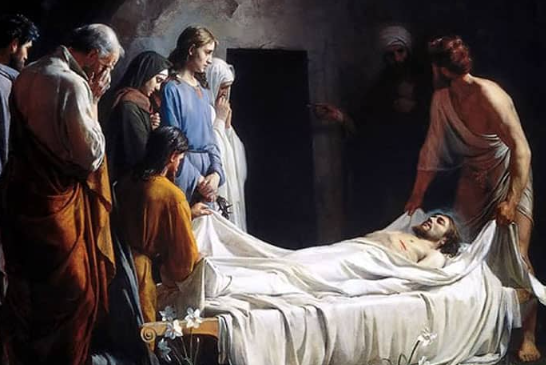
At some point in the course of those three years in which Jesus walked the hills and the shores of Galilee, Nicodemus saw in him a new way of being. At some point during those three years, Nicodemus had to admit to himself that he did not want to live in a world without love: at some point, Nicodemus became a follower of Jesus. He who first came to Jesus in the shadows of confusion stands by the Messiah on his Cross in the light of certainty. Somehow, here at the end of all hope, Nicodemus has gained the courage to take up his own cross in order to do the simple things that love calls him to do.
One can imagine Nicodemus on that Sabbath Day, Saturday, sitting in silence, still bathed in the overwhelming aroma of myrrh and aloe, the ointments having seeped into their very skin as he and Joseph rubbed the lifeless body of Jesus with perfume. In his loss, one can imagine the sweet perfume filling the heart of Nicodemus with memories of the Anointed One: his face, his voice, his touch, his laugh, his smile, his unconditional welcome, his way with words, and the great power of his love to take men and women and children from the hands of the Evil One.
As that long, terrifying, quiet Sabbath Day came to an end, and Nicodemus lay down upon his bed—under the dark red embers of sun-drenched clouds—perhaps his love for the Lamb of God was painted on the doorposts of his mind, so that cold Death passed over his heart, leaving his desire for a new creation smoldering under the ashes of his sorrow. Perhaps he fell asleep and dreamed with Ezekiel of dry bones rattling in the Wind. And maybe Nicodemus woke up suddenly sometime in the night, resolved to set aside every and all forms of judgment, abuse, and self-gratification.