9th Sunday after Pentecost
26 July A. D. 2026
Year A Readings
Genesis 29:15-28, Psalm 105:1-11, 45b, Romans 8:26-39
+Matthew 13:31-33,44-52
Collect
O God, the protector of all who trust in you, without whom nothing is strong, nothing is holy: Increase and multiply upon us your mercy; that, with you as our ruler and guide, we may so pass through things temporal, that we lose not the things eternal; through Jesus Christ our Lord, who lives and reigns with you and the Holy Spirit, one God, for ever and ever. Amen.
Homily
For the second day in a row, I have heard the scripture from Paul’s letter to the Romans in which he claims that nothing can separate us from the love of God in Christ Jesus, not even death. But we have a hard time believing this, because we are creatures of time, and we have not yet tasted the sweetness of eternity sufficiently to become immune to the bitterness of grief and loss. When I think of those in my life who have died, the heaviness and sorrow are sometimes hard to bear. Given this state of heart and mind, there was a particular line that jumped out at me in the story about Jacob and the family of Laban. After Jacob and Laban have made their agreement the story says, “So Jacob served seven years for Rachel, and they seemed to him but a few days because of his love for her.” That is what love can do… Turn seven years into a few days. And in a greater sense: Love can turn our long years of waiting for Christ to come into the twinkling of an eye, for in his love a thousand years are as a day.
I found this assurance deeply comforting, because I know that above all the things in my life that I cherish – all of my hard-won achievements and treasured possessions, all of my talents and abilities – it is the people I love that make my life meaningful. I think if loving and reconciled relationship with God and our fellow creatures is the promise of the kingdom of heaven, we have the capacity to experience that now, and perhaps our capacity to participate in the new creation here and now directly corresponds to our ability to face the world. We do grieve the suffering of the world… a suffering that is indeed very great. And We do grieve for the ones we love but see no more, but we need to not suffer the pain of uncertainty in the midst of our sorrow. Even the smallest act of kindness can move the dial toward the fullness of time. Even the briefest moment when love conquers prejudice is an instance of eternity breaking in to our experience.
This seems like another comforting thought, because I think most of us wonder what our small love can do against suffering and sorrow that feel so final.
I imagine that the people of Jesus’ time feel similar to us, because Jesus responds to the valid feelings of doubt and despair in each of the little parables collected by Matthew into his gospel. I’d like to talk in particular about seeds.
The idea that a seed could have within its DNA a blossoming shrubbery or towering tree frankly boggles my mind. Yet, there it is over and over again. And in fact, we’re no different. If you think about how big I am right now compared to the zygote looking for a place to settle in to my mother’s womb about 49 years ago…well. At about 4 weeks, a human embryo is about 1.5 millimeters tall. I am currently 1,879 millimeters tall. That’s a 125,166 % percent increase!
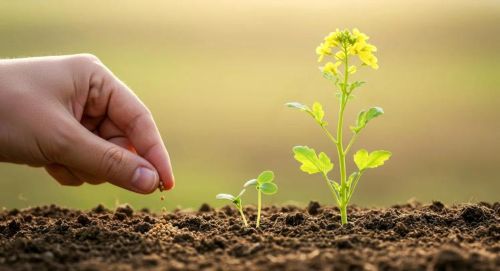
Jesus shared with his people that this incredible growth is how we can think about the kingdom of heaven in the midst of a dying world: like a mustard seed that begins as a spec and becomes a great tree.
Now think of love that way. Do you have love in your heart that is at least as big as a tiny spec? Jesus wants you to know that whatever amount of true selfless love you have in your heart and in your mind is the beginning of something big. If you and I can give our tiny love into the power of the Spirit, it will grow and grow and grow. And as it grows, it will make us strong, and the long years of sorrow and suffering and loss will become something that we find ourselves equal to.
All things in this life – all things – exist in the context of Christ coming again to renew the creation. And this means that nothing good will be lost. We often think about history as being the great teacher that will help us understand how to live in the present, how to make the right choices, and how to cope with human strife and loss. But I think we’ve got it backwards. It’s actually the future promised by Jesus which helps us discern what it means to be alive, and therefore what to choose, and how to love, and when to act. The future is context for the present. All things in human life, and in the life of planet Earth, are caught up in the great redemptive work of the cross, and no matter how small your love or joy or hope or faith may feel: water that seed… give it fresh soil… give it sunlight… pull the weeds… pick the rocks… and do all these things confident that nothing can separate us or any good thing from the love of God in Christ Jesus.
The famous author of children’s stories, Eric Carle, has a book called The Tiny Seed. In his book, this little spec of a seed has to make an incredible journey over mountains and oceans, across dry deserts and windy wastelands, until finally it comes to rest in the snow. In the long dark months, the seed has to avoid being eaten by mice and birds; and when it finally sprouts in the spring, it has to avoid being trampled by feet or plucked by hands. But at the end of this perilous journey, it grows into a flower that’s bigger than a house, and people come from miles around to marvel at its beauty. One time when I was reading this book to our five-year-old, Ian, he asked, “Daddy, do flowers really grow bigger than houses?” I think at the heart of his question is a young child’s innate desire to know what is to come, how life will unfold, and where his tiny life fits in to the world. I don’t think any of us ever outgrow those questions. What is to come? How will life unfold? Where does my tiny life fit in? At some point in life, we also add the questions: who will remember me when I’m gone, and what will they recall? All of these questions are questions about the future. And in the deep mystery of our faith – that Christ has died, Christ is risen, and Christ will come again – we have answers for each of these questions. When we nurture the love of Christ in our lives, we move in the direction of wholeness and flourishing life, even if we have to cross deserts of suffering and oceans of loss. For as we get deeper and deeper in love with Jesus, we find the suffering and sorrow of the world is in fact what is passing away. And as our love grows, the years of our labor and waiting begin to feel short, and we become more and more convinced of Paul’s notion that all life is converging in the goodness of God.
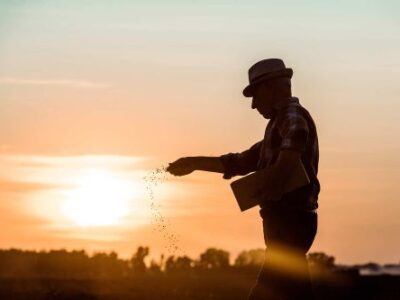
Some of us aren’t very good with plants. Even if we read all the instructions, every plant we work on seems to die. So let me tell you the good news… Jesus is the gardener: the one who goes out to scatter seed. And he’ll never stop planting his love in your heart until some of it lands in good soil, takes route, and begins to grow. He will never give up on us. He will give us light, water, and he will nourish us until his love becomes our love, so that the people we meet and befriend will find a home in our timeless welcome and embrace.
Thanks be to God.
Amen.