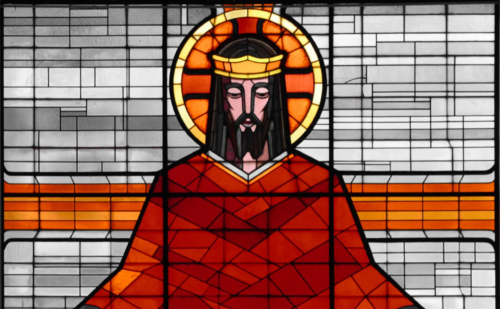
Who Is Christ the King?
On November 22 we will celebrate the Feast of Christ the King. I’m expecting that many of you will have heard of this celebration, but probably don’t know where it comes from or what the theological intention is. One of the reasons for this remains that this liturgical Day began as a Roman Catholic Feast, instituted by Pope Pius XI in 1925 as a response to the secularism which accompanied the political upheaval in Europe in the wake of the First World War. In his encyclical Quas Primas, Pius XI argued that the
manifold evils in the world were due to the fact that the majority of men had thrust Jesus Christ and his holy law out of their lives; that these had no place either in private affairs or in politics…
And he argued further that
as long as individuals and states refused to submit to the rule of our Savior, there would be no really hopeful prospect of a lasting peace among nations.
Over the ensuing decades, secularization continued in Europe, as well as the countries of North America, prompting one of the great moments in the story of Modern Christianity: The Second Vatican Council. Following Vatican II, Pope Paul VI chose to intensify the celebration of the reign of Christ by moving the date of the Feast to the very last Sunday of the liturgical Year and elevating it “to the highest rank of solemnity.” The effect was profound. No longer was the celebration merely an invitation for people to recognize Christ’s sovereignty, but stressed the evitable and unavoidable fulfillment of that sovereignty in Christ’s second coming. The shift implied that people and even nations can ignore the victory of Christ over all powers—both spiritual and temporal—but his victory is already history in his resurrection and ascension.
Vatican II began a wide-spread ecumenical consideration of how liturgy and ritual shape our imaginations, and many other denominational bodies added the celebration of the reign of Christ and his promised second coming. A wide swath of Christian culture clearly came to the conclusion that even as we look back to Easter, we look forward to the time when Christ will restore all good things to the intention of the Creator. We gain the strength to live faithfully in the present by allowing the promise of the New Creation to shape our minds. As one commentator in the ELCA notes: “We embody the presence of Christ. It is possible that the biggest barrier to accepting this as our lifelong vocation is not a lack of faith but a lack of imagination. On this final Sunday of the liturgical year, we receive a parable from Jesus challenging and inspiring our imaginations to grasp our whole vocation that is celebrated in baptism: to embody Christ in every moment and to engage every part of our world as Christ’s redeemed creation.”
Perhaps the strangest thing about following Jesus is that he will bring about his final victory partly through the witness of followers who live as though his victory were already complete. We shine light in places of darkness. We bring hope to places of despair. We bring joy to places of sadness. We bring self-emptying love into places of selfishness and greed. And we do this because the rituals and poetry and music and touch and silences of our worship have shaped our imaginations to see that nothing can prevent the coming of Christ. With minds sharpened like a two-edge sword, we face the violence and apathy of the world with a vision of Christ, coming “in his glory and the glory of the Father and of the holy angels.” (Luke 9:26)
This Day at the end of the liturgical Year should be, as Pope Paul VI intended, a celebration of the highest rank of solemnity. It is an entire celebration dedicated to that little phrase we say every week in our eucharistic prayers: Christ has died. Christ is risen. Christ will come again. Come celebrate on November 22nd, and bring all your friends and family. Like Christmas, Holy Week, Ascension, and Pentecost, celebrating the Feast of Christ the King is an essential that teaches us what it means to join with Jesus in Love’s Redeeming Work.
With anticipation and joy, Jonathan+