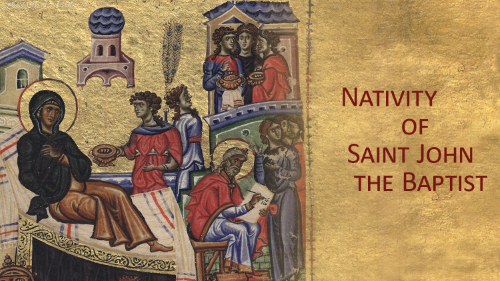
Nativity of John the Baptist
24 June A. D. 2026
Year A Readings
Isaiah 40:1-11, Psalm 85:7-13, Acts 13:14b-26
+ Luke 1:57-80
Collect
Almighty God, by whose providence your servant John the Baptist was wonderfully born, and sent to prepare the way of your Son our Savior by preaching repentance: Make us so to follow his teaching and holy life, that we may truly repent according to his preaching; and, following his example, constantly speak the truth, boldly rebuke vice, and patiently suffer for the truth’s sake; through Jesus Christ your Son our Lord, who lives and reigns with you and the Holy Spirit, one God, for ever and ever. Amen.
Homily
To be, or not to be, that is the question:
Whether ’tis nobler in the mind to suffer
The slings and arrows of outrageous fortune,
Or to take arms against a sea of troubles
And by opposing end them. To die—to sleep,
No more; and by a sleep to say we end
The heart-ache and the thousand natural shocks
That flesh is heir to: ’tis a consummation
Devoutly to be wish’d…
For who would bear the whips and scorns of time,
Th’oppressor’s wrong, the proud man’s contumely,
The pangs of dispriz’d love, the law’s delay,
The insolence of office, and the spurns
That patient merit of th’unworthy takes,
When he himself might his quietus make
With a bare bodkin? Who would fardels bear,
To grunt and sweat under a weary life,
But that the dread of something after death,
The undiscovere’d country, from whose bourn
No traveller returns, puzzles the will,
And makes us rather bear those ills we have
Than fly to others that we know not of?
William Shakespeare, Hamlet, Act iii scene i
In what remains arguably the greatest soliloquy in English theatre, Shakespeare’s character, Hamlet, muses upon the quintessential human question of suffering. All people beg the question of their suffering, and all people seek an answer to their question; for the human awareness of our existence forbids us from accepting the argument that our suffering is meaningless. Even at the very end of despair, aye, at the furthest extremity—with the “bare bodkin” in hand—a person seeks meaning in their suffering even in the act and choice of taking control of their fate.
At the time of Zechariah, the father of John, the suffering of the Hebrew people under the boots of the Roman Empire and their puppet kings was very great.[1] Indeed, the passionate jubilation of Zechariah’s song implies the depth of despair which must have characterized the years preceding the birth of his son. And even though, as a priest of the Jerusalem Temple, Zechariah was keeping the form of his faith, his despair seems to have been so deep that not even a vision of Angels in the Holy of Holies was enough to bring him out of it. When the Angel proclaims God’s faithfulness to him, Zechariah has no hope left in his heart with which to invest in this experience of revelation: the well of his heart is dry; the landscape of his imagination is desolate.
In her wonderfully artful book, Atlas of the Heart, the renowned professor of social work, Brené Brown, paints a picture of despair that helps us imagine the bleakness of life as a Palestinian Jew under Roman rule. “Despair,” Professor Brown writes,
is a sense of hopelessness about a person’s entire life and future. When extreme hopelessness seeps into all the corners of our lives and combines with extreme sadness, we feel despair. I once heard theologian Rob Bell define despair as ‘the belief that tomorrow will be just like today.’ When we are in struggle [and] experiencing pain…the belief that there is no end to what we’re experiencing… is a desperate and claustrophobic feeling. We can’t figure a way out of or through the struggle and the suffering.[2]
I would invite you to place yourself in the story and ask the human questions of suffering: How many miscarriages had Elizabeth and Zechariah suffered? How many friends and relatives of theirs had been taken and extorted or tortured or killed by the Romans? What was it like for Zechariah to serve as priest under the thumb of the blasphemous King Herod?
Taking in the full scope of their grief and despair, imagine then the joy that builds over the nine months of Elizabeth’s pregnancy: she misses her period, then a few weeks pass, then a couple of months and no miscarriage; then her body begins to change shape; until finally one day, Zechariah feels the movement of his child in the womb of his beloved wife. And imagine then, mute as he is, that the undeniable reality of that touch causes his whole body to be engulfed in a joy that floods the desert of his imagination with the assurance that God has not forgotten them.
Then the day comes when Elizabeth and Zechariah must circumcise and name their baby boy. The Angel of the LORD in the Holy of Holies commanded Zechariah to name his son John, but the extended family thinks this is nonsense because it’s not a family name… and clearly the son of Zechariah must take his name and follow in his father’s footsteps… because, you know, tomorrow will be just like today.
But Zechariah, able now to trust in the LORD with his whole heart, takes a tablet and writes, ‘His name is John.’ Immediately, his trust in the LORD is reckoned to him as righteousness—just like his ancestor Abraham—and his voice is set free. Filled with the Holy Spirit and born again from above, he erupts in a moment of praise that transposes his entire being into an ethereal place of knowing where the light of God’s faithful love breaks upon the darkness of his despair and illumines before him the way of peace. The Song of Zechariah is the Sacrament of his joy: for he knows that his little boy is the forerunner of the Messiah, the anointed one of God.
This revelation doesn’t make the suffering of Zechariah’s people go away, but it does allow Zechariah to face it differently. As Zechariah holds his little child in his arms, the words of all the prophets bubble up in him, words like those of Isaiah:
Comfort, O comfort my people,
says your God.
Speak tenderly to Jerusalem,
and cry to her
that she has served her term,
that her penalty is paid,
that she has received from the Lord’s hand
double for all her sins.
A voice cries out in the wilderness:
“Prepare the way of the Lord,
make straight in the desert a highway for our God.
Every valley shall be lifted up,
and every mountain and hill be made low;
the uneven ground shall become level,
and the rough places a plain.
Then the glory of the Lord shall be revealed,
and all people shall see it together,
for the mouth of the Lord has spoken.
All people shall see it together… the whole earth shall know the LORD. There will be peace.
Suffering and death continue, but the sting of death is removed. Physical pain is one thing, but the great existential agony of not knowing what lies beyond the veil of death is at best disquieting, and at worst terrifying. In the coming of the Messiah, heralded by John, Zechariah experiences a hope that is equal to all the pain and uncertainty of human life. And as his faith triumphs over his despair, he understands that death itself is being freed from the curse of the Evil One.
Our passage from this mortal existence was always the intention of the Creator. We cannot be mortal and achieve the intimacy desired by the Persons of the Holy Trinity. But our passage from mortality to immortality was never supposed to hurt. The birth of John is a sign that the Creator is actively working to raise up a people who understand that what we call life is only the beginning, and what we call death is only a doorway, and what we call suffering is not the will of God.
Surely Zechariah lived the rest of his life living the faith of Abraham, and calling on the God of David. Zechariah knows now, that in the end nothing can prevent the reign of God’s justice and mercy from coming: no empire, no suffering, and not even death. His song invites us to trust that in the darkness of our day, and in our own suffering, the dawn from on high will break upon us, and the light of God will guide our feet into the way of peace. Amen.
[1] See: “Jewish History, 331 BCE—135 CE” in The Jewish Annotated New Testament, Amy-Jill Levine & Marc Zvi Brettler, eds. (Oxford University Press: 2011), page 509 ff: “Roman Rule.”
[2] Brené Brown. Atlas of the Heart: Mapping Meaningful Connection and the Language of Human Experience
(Random House: 2021), page 102.