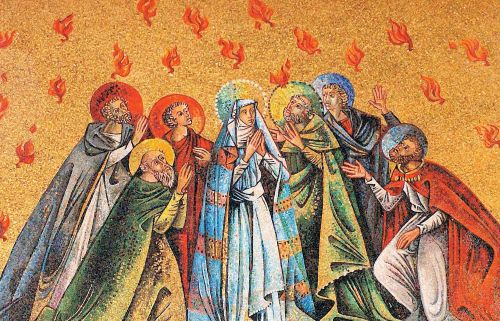
Pentecost
The Feast of the Pentecost
24 May A. D. 2026
Readings
Acts 2:1-21, Psalm 104:25-35, 37, 1 Corinthians 12:3b-13
+John 20:19-23
Collect
O God, who on this day taught the hearts of your faithful people by sending to them the light of your Holy Spirit: Grant us by the same Spirit to have a right judgment in all things, and evermore to rejoice in his holy comfort; through Jesus Christ your Son our Lord, who lives and reigns with you, in the unity of the Holy Spirit, one God, for ever and ever. Amen.
Homily
Over the last two weeks, we have traveled through that part of the Ancient Tradition of the Church which holds the Ascension of Jesus and the Coming of the Holy Spirit side by side, as if these two unexpected events are two sides of single coin. And it’s clear in all the scriptures which reference this singular moment that the Divine Plan of Redemption cannot move forward without the ascension of Christ and the condescension of the Spirit. Why then do we hear so little about the Ascension. Everyone comes to Christmas Eve. Almost no one comes to celebrate the Feast of the Ascension. But I’ll confess that I’m neither offended nor surprised by this, because if your experience of life in the church is anything like mine, you’ve rarely heard a pastor say anything memorable about Ascension. What this means is that most of us haven’t the foggiest notion of what the Ascension means. But this is a problem, for without some clear notion of why Jesus leaves, we will have no clear notion of why the Holy Spirit comes to humanity in this new way.
So, the 10 people who came to the Feast of the Ascension can “take 5” while I bring the miscreant wayward backsliders up to speed ; )
In my homily on the Feast of Ascension, I said that the departure of Jesus is a way of saving the Church from becoming a cult of personality. Like all good leaders, in his departure Jesus delegates to his disciples his mission, his power, and his love. In our culture, we have many expressions for this kind of thing: we pass the baton, pass the torch, hand over the reins, pass the mantle, step aside, give up the wheel—a nautical reference there… This is what happens between Jesus and his disciples when he takes off into some kind of interdimensional travel. The disciples are to take up his mantle and employ his authority to announce and enact the vindication of his resurrection. You will be my witnesses, Jesus commands them, when you have been clothed with power from on high. (Luke 24:48)
To take this a step further, if Jesus doesn’t ascend beyond the external perception of his disciples we have no Church, for the Church is no institution, cooked up by clever minds: the Church is the mystical Body of Christ, which are those who—at the silent, interior center of their being—have come to know Jesus of Nazareth as the Almighty Creative Love. So Jesus says to Thomas in preparation for his ascension, “Blessed are those who have not seen and yet have come to believe.”(John 20:29) Unless Jesus had not moved beyond their physical sight, the disciples never would have learned to seek him in any other way. Jesus leaves so that those who have followed him might love him more deeply still.
This interpretation of the ascension is not original to me. When St. Paul teaches the Corinthians, “…no one can say ‘Jesus is Lord’ except by the Holy Spirit,” he speaking about the contemplative dimension of the Gospel. Our perception of Jesus as Christ is an inward perception. And through the generations, the great Christian mystics have discovered and rediscovered this truth about the perception and knowledge of God. One such mystic was the Archbishop of Cambrai, François de Fénelon, who—in the late 17th Century—rejected the frivolous hedonism at the French Court of King Louis XIV in order to preserve his inner devotion to Jesus as Lord. In his meditations on the Ascension of Jesus he writes:
[O Savior] Thou art within us on the invisible altar of the sanctuary of the soul, the dwelling-place of true adoration. Here the pure in heart are truly offered to thee. Here all our selfish desires are destroyed and all our reversions to self and the preferences of self-love are renounced. Here we taste the true Bread of Life…The Word made flesh is given to us as our interior word—to be our language, knowledge, life, and being.
If we have known God through the senses, we no longer know Him the same way. Pure faith and pure love, nurtured in us by divine Truth, make us finally one with Him…I bear Him in my heart and glorify Him there.[1]
Fénelon discerns that without this inward knowledge of Jesus, human love for him remains confined to the context of our limited historical experience. Fénelon knows that this is a problem because our historical experience of the world, perceived by the intellect, cannot be separated from the finite cares of our immediate needs. And if we imagine that God is merely the answer to our immediate needs, we never experience God as the ultimate fulfillment of our deepest yearning: the desire to understand the meaning and brevity of our lives. Indeed, with the intellect we sing, He’s got the whole world in his hands, thinking the whole universe is not big enough to hold God; and yet Fénelon wants us to understand that the human soul is longitude enough for the Lord Jesus to make his dwelling there. Even so, the Lord says in the words of the prophet: “I dwell in the high and holy place and also with the one who has a contrite and humble spirit…” (Isaiah 57:15)
Time and Space—flighty concepts really. These things we imagine to be unyielding constants were malleable to the Risen Lord, who was already gone when the Tomb was opened, and who—as we see in our Gospel passage today—appears as if out of nowhere in a room where the door was locked and barred. Friends, in the power of the Holy Spirit, Time and Space are malleable for us too. Sure, the earth rounds on its axis every 24 hours, making our synapses cycle with the light of sun. But our existence is not measured in these increments of where and when: our days are not numbered! nor our weeks, our years, nor even our generations! To God we have never been anything but alive! We are eternally known, eternally loved, and eternally called. And when the Holy Spirit ignites the disciples with the inward spiritual apprehension of the truth of Christ, their historical expectations of Jesus are incinerated: they go from wondering when Jesus is going to reclaim the throne of David to proclaiming the justice and victory of a Universal Love.
What then are we to say about these things?
Simply what Paul said nearly two-thousand years ago: “To each is given the manifestation of the Spirit for the common good.” We might re-word this to say: To each is given a share in Christ’s ministry of reconciliation. The inward witness of the Spirit moves our hearts with the truth of Christ: that his condemnation of the money-grubber and the war-monger, and his exaltation of the poor and the peace-maker is in fact the way of being in the world that will lead humanity out of the valley of the shadow of death! When we perceive this Truth with the inner eye, the gifts of the Spirit begin to incinerate our prejudice against others and our loathing of ourselves. When the Spirit overshadows us like a hurricane and hovers over the deep places of our lives, then the knowledge and calling of Christ are conceived in the womb of our secret hearts, the radiant heat of his love melts the mountains of our prejudice and despair like wax, and flaming tongues of love, joy, peace, patience, kindness, generosity, faithfulness, gentleness, and self-control blast out through the roof of our minds, until we are, as Charles Wesley said: “lost in wonder, love, and praise!”
Jesus veiled his body from us so that we would stop looking for him outside ourselves. And the Spirit comes to us that we might find him within. The Spirit is the Guide, sent by the Father/Mother to lead us toward the molten center of our existence where the Living Word is forging the eternal elements of who we are into the tools of resistance, waiting for that moment when we are ready to “put on the whole armor of God.” Then:
Out to the world we go,
the love of Christ to prove,
anointed by the Spirit’s fire,
by grace born from above.
Our sin has been forgiv’n;
our wasted hope reclaimed;
victorious now, we follow Christ,
our hearts and minds aflame!
So may the Spirit’s pow’r
flow through the Church today,
just as it moved in days of old
when Christ from death was raised.
His promises we trust,
and for the world we take
the cross he bids us each to live:
and so, from age to age.
Justice shall be our song,
God’s glory to profess;
the peace of Christ to speak and show,
to breathe the Spirit’s breath.
The wise may call us fools;
the rich our love forbear;
but all who have no wealth to lose
will see and claim God’s care.
So let the poor rejoice;
let all the meek be blessed:
the Spirit’s call has turned our tide
of tears to joy at last.
The Day is very near,
the dark of Night is gone,
and in the Twilight we will sing
until our work is done.
[1] François de Fénelon. Meditations and Devotions, selected and translated by Elizabeth C. Fenn
(Morehouse-Gorham Co., 1952), pages 103-104.