The Visitation of the Blessed Virgin
1 June A. D. 2026
Readings
1 Samuel 2:1-10, Psalm 113, Romans 12: (1-2) 9-16
+ Luke 1:39-57
Collect
Father in heaven, by your grace the virgin mother of your incarnate Son was blessed in bearing him, but still more blessed in keeping your word: Grant us who honor the exaltation of her lowliness to follow the example of her devotion to your will; through Jesus Christ our Lord, who lives and reigns with you and the Holy Spirit, one God, for ever and ever. Amen.
Homily
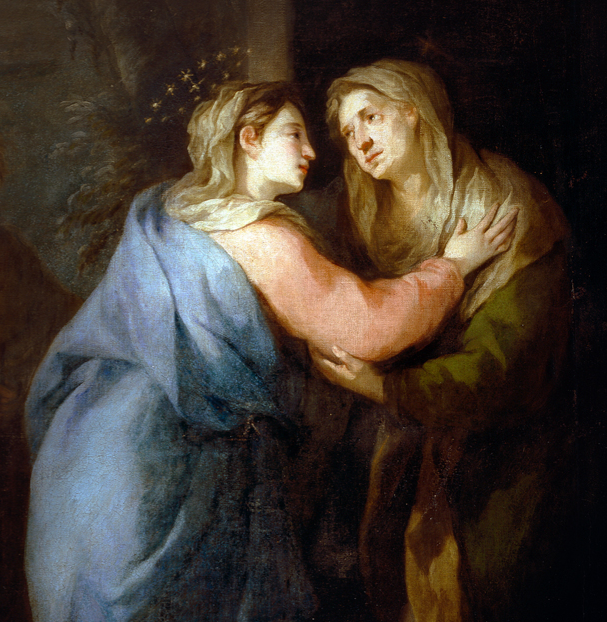
I have a sneaking suspicion that this Feast Day of the Visitation of the Blessed Virgin to Elizabeth is hardly ever celebrated because it hard for men raised in a John Wayne kind of Christianity[1] to focus entirely on women as the central agents of God’s unfolding redemption. The presence of Zechariah and Joseph is implied—as depicted in the artwork on the cover of this evening’s bulletin—but the revelation happens in this story through the bodies and the embrace of women.
Mary, some months pregnant, has traveled with haste, suggesting that when she comes within earshot of Elizabeth’s house, she cries out with urgency for her relative. She has news to share about her baby. And when the vibration of Mary’s voice careens into the eardrum of her relative, the tone of that cry fills Elizabeth with a sudden and rapturous spiritual energy. Suddenly she knows that here on her doorstep is the Mother of God. Poor Zechariah stands mute on the threshold wondering what the hubbub is all about, while Joseph holds the reigns and the packages, still trying to understand his strange young bride whose unbridled haste and joy continue to leave him with much to discern. And the two men fade entirely from view in the literary moment of Luke’s story, for in their embrace the two women become the absolute center of the universe. In the moment of their greeting, Mary and Elizabeth enter into an alienating privilege as they lose themselves in an ecstasy of pregnant touch and comprehension. In this deeply feminine and sensually embodied moment, Elizabeth and Mary are physically transported by the certainty of God’s faithfulness, power, and love. Their wombs have become their way of knowing, and they are lost in wonder and praise.
For me, this ecstatically physical moment of revelation prefigures St. Paul’s message to the Church at Rome: “…present your bodies as a living sacrifice, holy and acceptable to God, which is your reasonable worship. Do not be conformed to this age, but be transformed by the renewing of the mind, so that you may discern what is the will of God—what is good and acceptable and perfect.”
The renewing of our minds, you see, begins with the total dedication of our bodies to the adoration of our Creator. Our culture wants us to treat our bodies as our own. But our bodies are divine gifts to be shared selflessly like our minds and hearts, so that the moments of pleasure we are capable of draw us closer to the Creator instead of ripping us apart. When physical pleasure in all its manifestations causes mutual flourishing, we have begun to experience the life of the Holy Trinity: the Dreamer, the Builder, and the Bond Between Them.
When these two pregnant women unite their bodies in the holy intimacy of their greeting, they both flourish as a saving joy wells up between them, to overtake and finally wash away their fear and despair. What is made manifest in their mutual flourishing is nothing less than the Spirit of the New Creation.
As Mary and Elizabeth join in their prophetic embrace, what we find in them is the icon of a redeemed humanity, because in this moment their bodies have taken proper place in their knowledge of God: together, in their intimacy, they become a humanity which has undergone a sacrificium intellectus—a sacrifice of the mind.[2]Their way of believing the promises of God have ceased to be part of an arbitrary religious culture and have become mediated by a communal, visceral experience of embodied knowing. In the sacred intimacy between them we perceive how our human relationships are intended to be. We all are called to seek a holy intimacy with everyone God gives to us as neighbors; and when we follow this call, we discover through our bodies that our minds need not be chained to the false advertising of a culture which constantly encourages to self-gratification whatever the cost to ourselves, to others, or the planet. Faith seeks understanding, to be sure; but in the end, understanding is not achieved through a clarity of thought but through the embodied labor of private devotion, communal worship, interpersonal compassion, and societal justice. Pleasure is holy and sacred and is meant to make us one. In the mystical intimacy experienced by Mary and Elizabeth, we perceive the same Sacrament of justice and love which will be revealed in the Baptism of John and the Holy Cross of Jesus.
[1] See Jesus and John Wayne by Kristin Kobes du Mez
[2] John Shea. The Spiritual Wisdom of the Gospels for Christian Preachers and Teachers: Feasts, Funerals, and Weddings (Liturgical Press, 2010), page 204.