10th Sunday after Pentecost
2 August A. D. 2026
Year A Readings
Genesis 32:22-31, Psalm 17:1-7,16, Romans 9:1-5 + Matthew 14:13-21
Collect
Let your continual mercy, O Lord, cleanse and defend your Church; and, because it cannot continue in safety without your help, protect and govern it always by your goodness; through Jesus Christ our Lord, who lives and reigns with you and the Holy Spirit, one God, for ever and ever. Amen.
Homily
The renowned Irish singer/song-writer, Glen Hansard, died last week and the young age of 56. He was a precious and rare jewel of an artist whose poems and songs ring the heart betimes with gladness and humor, and with sorrow and longing.
But he wasn’t always famous. In a 2008 interview with journalist Terry Gross on her show Fresh Air, Glen shared a story about how his musical career began as a busker on Grafton street in Dublin. When he was 14 years old, Glen explained, his school principal lovingly sat him down and said, “Look son: you can tell me who produced Neil Young’s last album, but you can’t tell me the square root of 9. This school thing isn’t working for you, and it’s driving you and everyone else crazy. Why don’t you get your guitar and start your musical career right now. Give it a shot for a year, and if—after a year—it doesn’t work out, come back and we’ll figure things out.” Glen tells Terry how he left school that minute, went home, dropped off his backpack, and told his mother he was about to start his musical career. She encouraged him, and 42 years later, Glen Hansard died one of the most famous folk-rock singers of his lifetime, with accolades no less an Oscar for best original song. Glen will continue to inspire generations to come, because his music reveals the highest expression of the human spirit: the determination to participate in the struggle to live with a full heart despite the brokenness of the world.
Glen, like all public personalities, was open to close scrutiny. But if we have our eyes open as we go about, it is also possible to perceive this same determination in total strangers—and it’s just as inspiring. Just the other day, I saw the same determined hope which Glen sang about on the face of a young woman driving passed me in the opposite direction as I sat at a red light. As she turned toward me, she took the corner with a kind of decisive precision that grabbed my intention, because her speed was slightly elevated. She passed within a couple feet of me, and as the light caught her face, I experienced a crystal-clear glimpse of her face. There were so many feelings on that face all at once: she was focused, positive, thoughtful, powerful, curious, and… yes, determined. She was clearly lost in thought, apparently contemplating something of real importance to her, and she didn’t see me seeing her. So the complexity of her expression was entirely candid. And I said to myself, “Hokey Smokes! She’s gonna accomplish whatever it is she’s fixin to do!” (yes…I really do talk like a hill-billy). That nameless stranger inspired me in the split second that her clear determination to participate in the human struggle to thrive flashed in and out of my experience.
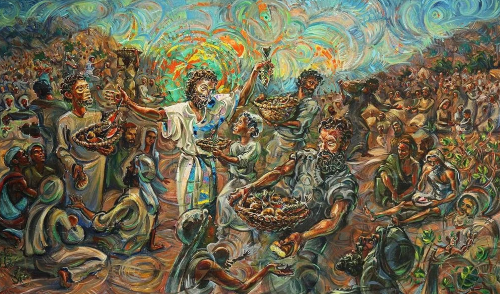
As the supper hour arrives for thousands of people in the wilderness of the Judean countryside, I feel like Jesus invites his disciples into this human struggle to thrive when he says “You give them something to eat.” And we need to make sure that this invitation inspires us, because it might easily overwhelm all our senses.
Keep in mind that just before this story takes place, Jesus’ own cousin, John the Baptist, had been brutally and unjustly executed by beheading in the dungeons of Herod’s palace. Our story today begins with Jesus and his friends suffering a deep and shattering grief, seeking solitude to process the devastating news of John’s death. But just when they think they’ve reached a place of quiet, they realize that thousands of desperately needy people are jockeying for position to be the first in line when they step out onto the beach. “How then can this story feel anything but overwhelming?” you might ask. Neither Jesus nor his disciples have what they need!
At the climax of the terrible strain experienced by the disciples comes the astonishing moment of Jesus’ command: “You give them something to eat.” And the disciples understandably crumble, explaining that they don’t even have enough for the thirteen of them to have a sufficient meal, let alone thousands. But what they’ve forgotten in their misery and grief is that, with Jesus, the over-abundance of the kingdom always seems to begin with almost nothing. The disciples had heard him talk about mustard seeds, and the yeast in the flour… about seemingly empty fields hiding treasure, but now it was time for them to experience a parable of the kingdom in real time, in real life. In this moment of crisis, the disciples believe that feeding these people is impossible. Jesus knows that it is not. Jesus knows that if they address the situation with unity, positivity, thoughtfulness, confidence, curiosity, and… yes, determination, they will perceive possibilities that were there all along but had been overlooked in their state of sadness and exhaustion.
The invitation of the miracle, then, is to stop imagining that we can face the struggles and evils of this world on our own steam. Jesus waits for the disciples to hit rock-bottom, and then says: Bring me the food you have. What the disciples then discover is that, if they will give what they have to Jesus, however little it is, Jesus will take it and multiply it beyond anyone’s imagination.
Jesus entrusts his ministry to us, but he wants us to entrust our lives to him. We can do nothing without him, and yet as the Apostle Paul reminds the Philippians, we can do all things through Christ, who strengthens us.[1] As Presbyterian scholar and pastor, Clifton Kirkpatrick points out about this passage,
To follow Jesus is to express our faith in concrete acts of love, justice, and compassion toward others. …when we need it most, God will give us the power to work for good in the world, a reality many of us have discovered when faced with situations we were not sure we could manage. […]
The promise of the story of the feeding of the [thousands] is that if we join together in unity and faithfulness, God will be with us. It is not a promise of the absence of struggle and pain—Jesus even had to go the way of the cross—but a promise that God will be with us and that God’s intention for love, peace, and justice in the world will ultimately prevail.[2]
Kirkpatrick highlights the connection between our great need and God’s power to sustain us. What is your great need today? Can you identify with the heartache and fatigue of the disciples? Can you identify with St. Paul as grieves for his people while persevering in his ministry? What is your great need today? And can you hear Jesus saying to you what Jesus said to them, bring me what you have: it will be enough, you’ll see… more than enough.
In one of his most beloved songs, “Bird of Sorrow,” Glen Hansard sings about the invitation of love and hope in the midst of despair. These are his words:
Even if a day feels too long
You feel like you can’t wait another one
You’re slowly givin’ up on everything
Love is gonna find you again
Love is gonna find you, you better be ready then
You been kneelin’ in the dark for far too long
You’ve been waitin’ for that spark, but it hasn’t come
Well I’m callin’ to you, please, get off the floor
A good heart will find you again
A good heart will find you, just be ready then
Tethered to a bird of sorrow
A voice that’s buried in the hollow
You’ve given over to self-deceivin’
Your prostrate bowed with not believin’
You’ve squandered more than you could borrow
You’ve bet your joys on all tomorrows
For the hope of some returnin’
While everything around is burnin’
Come on, we gotta get out of this mess we made
And still for all our talk, we’re both afraid
Will we leave this up to chance, like we do everything?
Love is gonna find us again
Love is gonna find us, we gotta be ready then
Tethered to a bird of sorrow
A voice that’s buried in the hollow
You’ve given over to self-deceivin’
Your prostrate bowed would not be leavin’
You’ve squandered more than you could borrow
You’ve bet your joys on all tomorrows
For the hope of some returnin’
While everything around you’s burnin’
But I’m not leavin’ you yet, I’m hangin’ on
With the faithful, I’m hangin’ on
Beloved in Christ, whatever we have that is good, that is wholesome and loving and just, no matter how small it may seem, let us come together in the unity of the Holy Spirit, and place all we have and all we are in the hands of the Lord.
It will be enough, you’ll see.
[1] Philippians 4:13, paraphrased
[2] Clifton Kirkpatrick, “Pastoral Perspective” in Feasting on the Word, Year A, Volume 3 (Westminster John Knox:
2011), Proper 13, pages 310 and 311.