3rd Sunday in Easter
Easter III
April 19, 2026
Year A Readings
Acts 2:14a,36-41, Psalm 116:1-3, 10-17, 1 Peter 1:17-23
+ Luke 24:13-35
The Collect
O God, whose blessed Son made himself known to his disciples in the breaking of bread: Open the eyes of our faith, that we may behold him in all his redeeming work; who lives and reigns with you, in the unity of the Holy Spirit, one God, now and for ever. Amen.
The Homily
Many times over the past several days, I’ve been greeted with the words, “Welcome back!” Now it’s my turn to offer those words joyfully to all of you:
Welcome back!
Welcome back to this quiet time on the Lord’s Day.
Welcome back to this moment of peace amidst the violent struggles of our world.
Welcome back to this time of singing, of breathing, of keeping silence.
Welcome back to the promise and affirmation of God’s love.
Welcome back to this sacred space, this light, and the Presence here of the Risen Lord.
Welcome back to eternal life.
Welcome back to Resurrection.
Let us pray:
God of grace and God of flourishing life,
you have called us out of darkness into your marvelous light.
Feed us now with the Heavenly Bread of your Living Word,
that all the hungry places in our lives might be filled.
We ask this in the Name of Jesus Christ. Amen.
While I was away, Fr. Mike Fedewa, our cherished friend, acknowledged the difficulty all of us occasionally experience in believing. Often our minds simply won’t go where our hearts long to lead us. Whether we have brief episodes of doubt and discouragement, or whether we’ve lived our lives wondering why we don’t have the same exciting experiences others talk about, we all know what it means to feel incredulous about the resurrection of Jesus from the dead. I want to reiterate what Mike showed us last week: That’s ok. Doubt doesn’t make us less eligible for the love of Jesus. And a struggle to believe will never diminish our longing to understand the nature of our existence and the love that makes us whole. And in the end, our intellectual struggle is valuable, because our inability to explain the resurrection of Jesus in a way that satisfies our minds, points us to other ways of understanding. Far from separating us from God, Jesus is at the very center of our doubt.
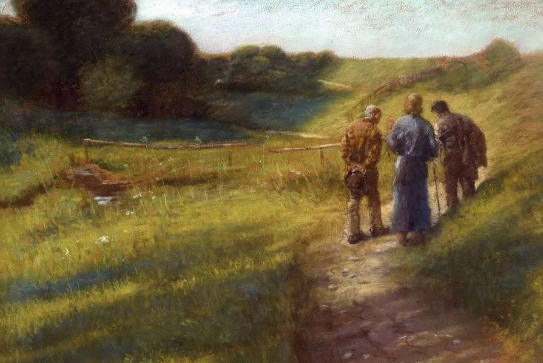
This promise is made very clear in the episode between Jesus and Thomas, which you all explored last Sunday. And it’s equally for certain in our Gospel passage today from Luke, in which Jesus responds to the incredulity of Cleopas and his companion with light-hearted chiding and an invitation to enter the mystery of the resurrection.
I think it matters a great deal how we imagine that moment, so let us recall that in all of the moments on the Day of Resurrection when Jesus greets his friends, he speaks peace to them and rehabilitates their relationships by taking away the guilt and shame of their betrayal. Let us return to this moment between Jesus and Cleopas and their companion:
…some women of our group astounded us. They were at the tomb early this morning, and when they did not find his body there, they came back and told us that they had indeed seen a vision of angels who said that he was alive. Some of those who were with us went to the tomb and found it just as the women had said; but they did not see him.” Then [Jesus] said to them, “Oh, how foolish you are, and how slow of heart to believe all that the prophets have declared! Was it not necessary that the Messiah should suffer these things and then enter into his glory?” Then beginning with Moses and all the prophets, he interpreted to them the things about himself in all the scriptures.
When you hear Jesus say, “Oh how foolish you are and slow to believe,” how does his voice sound to you?
How does his face look?
What’s your experience of one stranger telling another stranger how foolish they are?
When you’ve remarked upon the foolishness of a stranger—say, while driving—what was the demeanor of your heart and mind?
As Jesus responds to his disciples, his facial expression, body language, gestures, and tone of voice mean everything. So we have to interpret this scripture intentionally and carefully: these non-verbal cues will either increase the disciples’ experience of fear and shame, or give them their own new life.
There’s a book I love reading with my son, Ian, in which the reader follows the story of someone who wrote to the zoo for a pet. They send a lion, but she’s to fierce. They send a snake, but he’s to s s s s s s-scary. And they send a monkey, but he’s to naughty. Now when I get to the bit about the naughty little monkey, I put the book down and tickle Ian and say, “Oooooo you naughty monkey!” and he squirms and laughs and says, “I’m not a monkey dad!” He also knows—because of my tone of voice that he’s not naughty. In fact, quite the opposite: Ian can tell from my voice and touch and face that he is loved unconditionally, completely, and forever.
When Jesus says to Cleopas and his companion “Oh how foolish you are, how slow to believe…” what if we imagine that he wants to tickle them, because he loves them unconditionally, completely, and forever. I think Jesus must have said those things in a way that made Cleopas and his companion smile and blush with new hope in spite of themselves.
We’ve given in to the yearning of our hearts again today. We’ve come back here again in search of something… of someone. My prayer is that we each may find the great Lqover of our Souls walking alongside of us. It will happen uniquely— in different ways for each one; but no matter how Jesus speaks to us, his tone will be light, there will be a twinkle in his eye, and as his love gives new hope to our lives, perhaps our hearts will burn within us…
We’re going back out there, into a world of darkness, of sadness, of fear and anger and self-gratification. May the glow of our burning hearts illumine the paths Christ calls us to walk. May we join with the Army of Angels who, at the birth of the Incarnate Word, sang a new song of peace: for a Light shines in the Darkness, but the Darkness comprehendeth it not.
Amen.