Maundy Thursday
Maundy Thursday
4/2/26 John 13: 1-17, 31b-35
Sermon by Deacon Kim Hoop
Love one another as I have loved you.
These are powerful words—Jesus had completed his work on earth and was spending his last hours with his disciples. They had gathered to share one last meal in an upper room, in Jerusalem, during Passover. And, to spend a precious small amount of time together. Jesus however, uses this time to prepare his disciples for his death and to impart one more teaching by word and example.
Jesus wants the disciples to love and serve one another, and Jesus proceeds to give them a demo by washing their feet.
Foot washing was an ancient custom and was considered to be a very personal and intimate act. The custom was thought to have originated in Egypt and Mesopotamia, and was very much a part of life during the time of Jesus.
However, there is a reference to it in the Old Testament. When Abraham was visited by the three men. (Genesis 18 verse 4) Abraham said to his guests, let a little water be brought and wash your feet and rest yourselves under the tree.
Foot washing was also considered to be a very menial task, as culturally the underside of the foot was considered to be “dishonorable”, and that is why foot washing was done by a servant or person of low status.
One source suggested that the foot washing was done primarily by women. It could also be done by the person themselves or if it was a teacher/student encounter as ¡t was with Jesus, then the students were expected to wash the feet of their teacher.
Jesus upends the social protocol that a superior doesn’t wash the feet of those with low social status by proceeding with the foot washing of the disciples. On that night it is interesting to note that the disciples apparently did not wash the feet of Jesus or the feet of each other. The act of foot washing was not only for hygiene, but was also seen as a sign of hospitality, especially when entering a home.
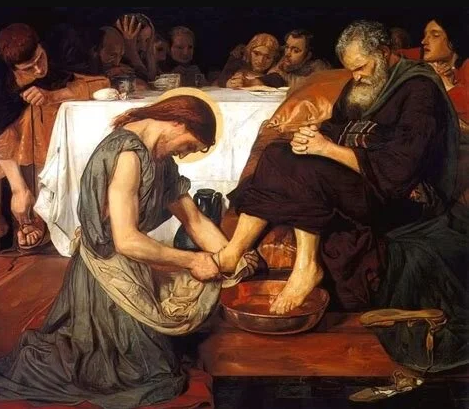
During the meal, Jesus got up and removed his outer robe and tied a towel around himself. He poured water into a basin and began to wash the disciples feet. Jesus did the foot washing in community to serve as a model for discipleship. Each disciple was loved and valued as a member of the community.
When Jesus got to Peter, he asked Jesus “are you going to wash my feet?” Jesus responded “you do not know now what I am doing, but later you will understand”. Peter then refused. Jesus responded that unless I wash you, you will have no share with me. Meaning that Peter would not be able to be in relationship with Christ. Peter then consented to the foot washing.
Jesus’ purpose for doing the foot washing may have been in part hygenic, but according to a number of sources it was a spiritual cleansing of sin followed by forgiveness. And Jesus was also modeling for his disciples humility, servanthood and love. In particular, unconditional love. God׳s love. This is love that is without conditions, limitations or special terms, it is not driven by ego or guilt, and it happens no matter what, it cannot be earned and it does not change. One example is when Jesus reached out and washed the feet of Judas, who he knew would betray him, Peter who would deny him and the rest of the disciples who would desert him.
Some sources said that Jesus may have also been symbolically washing off the dust of the past and old ways from the disciples feet in preparation for their new ministry after Jesus’s death and resurrection.
This new ministry would require the disciples to go from being students and learning from Christ to doers of his words and teachings, actually putting into action what Jesus taught, modeled and preached – sharing the good news of Christ, his death and resurrection and what he taught and lived out as an example to all who believed in him.
From the disciples work and ministry (according to one source) Christian communities would form, and using the blueprint that Jesus left for his disciples for Christian living, would be the blueprint for sharing the Gospel and God’s love. And under the guidance of the Holy Spirit the disciples would become Christ’s ambassadors living out the Gospel by words and actions in communities in and outside of Jerusalem.
Our Gospel lesson closes with Jesus saying “I give you a new commandment: that you love one another as I have loved you. You should also love one another. By this everyone will know that you are my disciples, if you have love for one another.״ This includes humble, loving service to others, especially for those in need.
So how do we in 2026 carry out this commandment in our lives as followers or disciples of Christ?
Well, Mother Teresa once said that “love in action is service to others”, and that includes things like serving and feeding the hungry, helping to house the homeless and work for justice for everyone. Have respect for those who are different from us. Put others before ourselves, and take a stand for those who are treated badly in our society. Take steps to help others who are struggling. Strive to help make a difference in the lives of others.
And, these things are important, but Jesus pointed out by his words and foot washing that the small mundane things and everyday tasks in life are also important.
One devotional writer (from Christ in our Home) speaks to the importance of daily mundane tasks, as we no longer wash feet today as part of our society.
I would agree and venture to say for example that most, if not all of us in our lifetime have cleaned and bandaged scraped knees, walked the floor with a sick or frightened child at some crazy hour of the night.
Or perhaps have taken a meal to a sick neighbor, taken someone to a doctor’s appointment, cared for sick or aging parents, or truly listened to someone with a broken heart.
Jesus didn’t verbally address mundane, he did however address love, humility and service to others in the way that he led his life. And perhaps he is asking us to do the same as ״true greatness comes from humility, love and service in action”.
We will soon be focusing our attention on Easter Day and the joyful resurrection of Christ from the dead. Let us remember that we are the hearts and hands of Jesus and are called to carry out his mission in the world. That is to love one another guided by the Holy Spirit, as Christ loved us.