3rd Sunday in Lent
The Third Sunday in Lent
8 March A. D. 206
Year A Readings
Exodus 17:1-7, Psalm 95, Romans 5:1-11 + John 4:5-42
The Collect
Almighty God, you know that we have no power in ourselves to help ourselves: Keep us both outwardly in our bodies and inwardly in our souls, that we may be defended from all adversities which may happen to the body, and from all evil thoughts which may assault and hurt the soul; through Jesus Christ our Lord, who lives and reigns with you and the Holy Spirit, one God, for ever and ever. Amen.
Homily
Come, let us sing to the Lord;
let us shout for joy to the Rock of our salvation.
Let us come before his presence with thanksgiving
and raise a loud shout to him with psalms.
For the Lord is a great God,
and a great King above all gods.
In his hand are the caverns of the earth,
and the heights of the hills are his also.
The sea is his, for he made it,
and his hands have molded the dry land.
Come, let us bow down, and bend the knee,
and kneel before the Lord our Maker.
For he is our God,
and we are the people of his pasture
and the sheep of his hand.
Oh, that today you would hearken to his voice!
It seems to me that too often in our lives, we struggle with the false impression that we don’t matter. Whether the culprit is
an abusive employer,
a neglectful partner,
a bullying sibling or parent,
a fickle friend,
or a society obsessed with celebrity,
someone, at some point, make it clear to us that we didn’t matter. These experiences mark us, and the wounds of those marks stay with us, even if we move on from the situation or the relationship. But the message that we don’t matter is false, and I’m so thankful that we have a chance to see a completely different message in the Gospel today.
You may or may not know that by the time of Jesus, the Jews and the other semitic peoples of Palestine—including the Samaritans—had been antagonistic towards one another for hundreds of years. When the descendants of the exiled Hebrews returned from Babylon, they didn’t mix well with the people who lived there. The returning exiles even refused the help which the locals offered to rebuild Jerusalem, along with its Temple. To be fair, the Jews interpreted the devastation of their exile as the result of unfaithfulness to the LORD. As a result, however, they became obsessed with purity and segregated themselves from the other people. The Jews returning from exile would have nothing to do with their neighbors and viewed them as mixed-race idolaters.
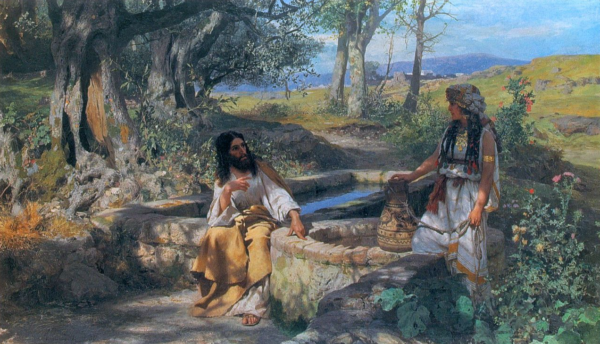
As we consider the encounter between Jesus and the Samaritan Woman at the Well, it seems wise to recall the four-hundred years of prejudice which they’ve both inherited from their cultures of origin. In any case, the Samaritan Woman immediately highlights their differences when Jesus speaks to her, and upon their return from the market the disciples tacitly do the same. To Jews, the Samaritans didn’t matter, and contact with them was to be avoided at all cost.
Jesus sees things differently. For Jesus, bloodline, religious beliefs, and cultural assumptions are not the criteria by which the value of a human being is judged. For Jesus, every person matters.
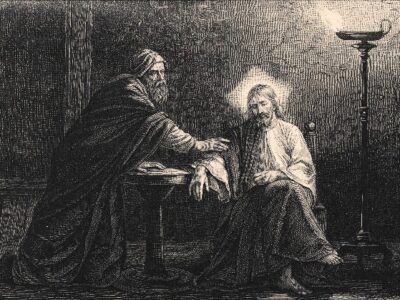
Consider, for instance the differences between Nicodemus in the Gospel last week and this Samaritan Woman:
Nicodemus is a leader of the Jews:
– he’s a pharisee, which means he’s educated, which means his family had wealth when he was a child…
– now he is, presumably, the head of his own household…
– he has a position of elevated social standing, which includes the continued privileges of wealth, property, and relative political security…
– Nicodemus works with his mind and not his body, and so he has the luxury of coming to Jesus with his questions in the middle of the night because he can physically afford not to sleep…
The Samaritan Woman is the opposite of the Pharisee:
– she’s either been divorced or widowed 5 times…
– currently she doesn’t matter enough to the man she lives with for him to marry her…
– which implies that she’s poor and vulnerable…
– which means that she works in menial labor—like drawing water and carrying it back to town—in order to earn food, shelter, and clothing…
– presumably, since she has no leisure time, she has no formal religious training except the assumptions of her culture…
– which implies that the deep questions of her heart are feelings that she stifles, since asking questions is a luxury reserved for those with power and time to think…
– she would never seek out a religious teacher, even if she had the energy and time, which she does not…
Despite these stark differences, these two people are of equal value in the sight of the Messiah. Jesus considers both Nicodemus and the Samaritan Woman worthy of his regard and attention, and Jesus reveals his divinity to each one. Indeed, when we hold up John chapter 3 and John chapter 4 side by side, the radical nature of Jesus’ welcome becomes obvious. In chapter 3, Jesus teaches the teacher that God’s covenantal love goes beyond the Jews. To Nicodemus, Jesus says “God so loved the world…” And in chapter 4, the story concludes with the Samaritan town’s folk exclaiming with delight that the Jewish Messiah is “truly the Savior of the world.”
The Savior of the world,
the Living Word confined in time and space
through the supreme act of LOVE.
Everyone is beloved: no exceptions!
Everyone matters: no exceptions!
How often we have lived as if the Gospel were not true. Too often we have listened to the voices of the world, which tell us our bodies are not beautiful, our ideas are too ordinary, our hopes are too foolish, and our faith is too weak. And the wounds of these lies have caused us to do terrible things. In our trembling doubt and insecurity, we allow sadness to become resentment, and resentment to become anger: and unrequited anger leads to all kinds of violence against ourselves and others.
The Lenten message then is this: if we find ourselves wounding others—especially those the wider culture fears and condemns—we need to stop and reflect on what is wounded in ourselves. My guess is that it wouldn’t take any of us long to think of a moment—or even a time in our lives—when we were made to feel like we didn’t matter.
It’s time to lean into the Gospel, my siblings in Christ, because this world of ours is desperate for love and affirmation: a kind of affirmation that gives power to endure the suffering of our time; a kind of affirmation that reshapes our character and our way of being; a kind of affirmation that produces hope. Let us take Jesus seriously and stop living as if we do not matter. Let us walk the Way of Jesus, that others might also come to know a Savior who has not abandoned us to either a meaningless life or a lifeless death.
Amen.