2nd Sunday in Lent
The Second Sunday in Lent
1 March A. D. 206
Year A Readings
Genesis 12:1-4a, Psalm 121, Romans 4:1-5, 13-17
+ John 3:1-17
The Collect
O God, whose glory it is always to have mercy: Be gracious to all who have gone astray from your ways, and bring them again with penitent hearts and steadfast faith to embrace and hold fast the unchangeable truth of your Word, Jesus Christ your Son; who with you and the Holy Spirit lives and reigns, one God, for ever and ever. Amen.
Homily “Urgings of the Heart”
Once upon a time, when I was earning my living as an operatic baritone, I got hired as an adjunct professor of voice at one of the schools in the Tennessee State University system near my home in Nashville. During the course of that work, I became friendly with the school’s director of choral studies, Dr. George Mabry. George is a collaborative person and was happy to work together. He invited me to join the professional chamber chorus of the Nashville Symphony Orchestra, of which he was also the director, and—having loved choral music my whole life—I readily agreed.
For many reasons, I’ll never forget one particular concert series which featured the chamber chorus in performances of Johann Sebastian Bach’s timeless and incomparable Mass in B Minor. The music is technically difficult and worth all the effort of mastering it, rewarding those who get passed learning the notes and words with a profound exploration of the nature of God in Christ. Needless-to-say, as a musician who was also a Christian, the experience captivated my feelings and imagination.
Getting a handle on some of the tougher passages of music was also gratifying to my thirty-two year old ego. During the final rehearsal, the bass section nailed a particularly difficult passage, after which the conductor, Helmut Riling—a renowned scholar of Bach’s music—looked up over the orchestra at us and said, “Well gentlemen, well done… yes, well done!”
I left that rehearsal on cloud 9, and as I walked out the stage door of the Nashville Symphony into that cold Winter night, I was absolutely aglow with the staggering beauty of Bach’s genius and the joy of making music. Humming tunes and smiling, I went out onto the dark street, taking great strides towards the parking lot. But the traffic light changed, and I had to stop at the intersection of Demonbreun St. and 4th Avenue.
Suddenly, a figure emerged out of the shadows and approached me. Coming into the galvanized grey light of the street lamps, I could see that he was holding out his hands, which contained some crumpled bills and some silver.
“Excuse me,” he said hesitantly.
“Hi!” I replied, still full of musical effervescence.
“I’ve got a few dollars here,” the man explained, “but it takes $12 to get into the Salvation Army shelter for the night. Can you help me?”
After a moment of hesitation on my own part, I replied with condescending conciliation, “I’m so sorry, but I don’t have any cash.”
“It’s ok; thanks anyway,” the man said, as he backed away into the shadows.
The mood changed for me as I drove home. I realized that it wasn’t that I was unable to take that man to the shelter, it was that I was unwilling to go to the ATM and get the money and go with him, making sure he got in safe and sound. In the darkness, as the headlights flew past, I felt an urging of the heart. I thought back to the great weeping music of the Crucifixus, through which Bach cradles the grief of Jesus’ execution with exquisite tenderness. And I too began to weep, knowing—as my brain caught up with my heart—that I had avoided an opportunity to live the love I had been singing about.
Unlike that homeless man, I got home safe and sound, but I didn’t sleep. I wrestled with the bed covers, glaring at the ceiling, until I finally got up to pace the darkness: talking to the furniture, and then to the floor, and then to the dark outside the windows. At some point in that strange conversation with myself, I came to a point of knowing without any shred of a doubt that, whether or not I called myself a Christian, I was no follower of Jesus. I came to a point of knowing that if I was going to be his disciple, my way of being in the world would have to change. Six months later I was enrolled in the Master of Divinity program at Vanderbilt Divinity School.
All of us have our own path; Divinity School was mine. But the truth holds: If we’re going to be disciples of Jesus of Nazareth, our way of being in the world will have to change. I’ve been reminded of that truth many times these last 15 years. And during this moment in history—this moment of war and violence—it seems to me more relevant than ever.
So, with gentleness and faith, I ask you, beloved in Christ, if you will consent to keep silence with me for a moment, that we might acknowledge a questioning Savior, who stands and knocks at the door of our secret hearts, asking with heartbroken tenderness: “Where are you? Why have you not returned my love? Why have you not loved the ones I’ve given to you as neighbors?” Enter with me, if you will, into the terrifying silence of Lent and listen with “the ear of your heart” for the movement of the Lord.
Silence
There’s a book about Christian Mysticism called Contemplative Life: Discovering Our Path Into the Heart of God. The author is Julie Saad, a spiritual director who teaches about what it feels like to live a life of consent to the Divine Spirit who comes to dwell in us. Practical wisdom and guidance is on nearly every page, but for our purposes today I want to share Julie’s reason for writing the book. She introduces her book this way:
Contemplative life begins when we take the first step into the silence of our heart. It’s a pilgrimage—a journey that takes us first to the inner reaches of who we really are, and from there, into the life we were meant to live. We don’t usually start a journey like this unless we’re searching, even longing, for a different way of life. The search often begins when we experience an existential crisis, a trauma, a loss, or sometimes just a weariness with the way life is. It may be a search for purpose or meaning, or a desire for a deeper connection with the Ultimate Mystery. […] It doesn’t matter where you are on your life’s path, whether you’re young or old, experienced in prayer or a novice, religious, spiritual, agnostic, or none of the above. What matters is that something deep in the silence of your heart called you to take the first step.[1]
What Julie describes is, I believe, what happened to me on that dark street corner in 2010. And it is exactly how we find Abram at this moment in his story. Right before the passage we’ve heard today, the Book of Genesis tell us that Abram’s brother, Haran, has died; his father, Terah, has died; and Abram’s marriage to Sarai remains childless. Think for a moment; put yourself in Abram’s shoes. Here is a person whose life is filled with grief and uncertainty, or as Julie Saad puts it: full of trauma and loss, leading to an existential crisis. Abram has come to the end of himself, and it is at this moment of feeling completely lost that the LORD prompts Abram in the “deep silence of his heart” to “take the first step…” to “Go.”
That simple English verb “go,” however, doesn’t really do just to the Hebrew verb lek-leka, which is conjugated in the imperative form and includes the preposition “out,” so that it literally means “get out.”[2]
Get out of your country
Get out from your family
Get out from the house of your father
In Hebrew, the urgency of Abram’s prompting is clear. The LORD saw that Abram was yearning for direction and meaning and purpose. So, the LORD gave Abram a prompting that was so emphatic that Abram packed up all his belongings and household and left the grave of his father behind: turning not east to the land of his people, but west toward the unknown of God’s promised blessing. In order to be true to himself, Abram had to follow the urging of his heart: he had to find a new way of being in the world; he had to change.
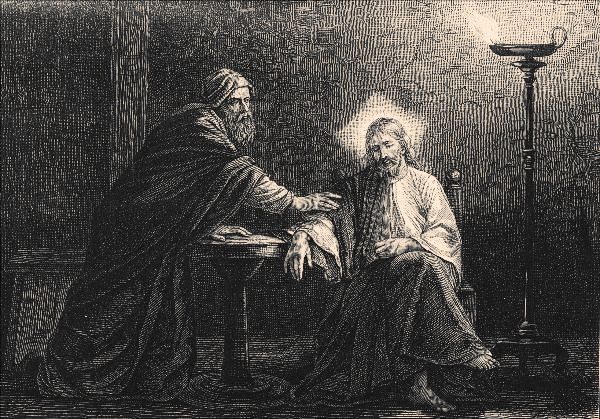
We find Nicodemus in a similar mood, leaving the quiet safety of his house in the middle of the night to following a prompting he doesn’t yet understand. Rather than being grief stricken and lost like Abram, however, Nicodemus is perhaps what Julie Saad describes as “weary with the way life is.” Nevertheless, what an extraordinary action for an eminent, respectable pharisee to take.
Nicodemus sees in Jesus something more than the rabbinical status quo, and he’s so fascinated that he can’t sleep. And when his questions get bigger than his religion, an urgent desire to understand propels him out of bed, into his robes, down the hall of his house, and out the front door, to steal furtively through the starlit streets to where the Rabbi Yeshua is staying. In Jesus, Nicodemus observes a way of being in the world that rings true to the promised blessings of God, while yet having nothing to do with the fastidious, institutional control of the Temple. Apparently, that fastidious institution is losing its appeal for this faithful pharisee. When held up against the light of the Jesus, everything else seems dark.
In a curious exchange, Jesus affirms the urging of Nicodemus’ heart as the prompting of the Holy Spirit:
Nicodemus says, “we know that you are a teacher who has come from God; for no one can do these signs that you do apart from the presence of God.” In other words, “I see, Jesus, that you must be a prophet of the Lord.”
To which Jesus replies, “No one can see the kingdom without being born from above.”
Jesus’ reply is what we would call a back-handed compliment. The fact that Nicodemus recognizes the divine origin of Jesus’ ministry means that Nicodemus must be born from above. Jesus personifies the kingdom of heaven, and seeing the kingdom of heaven requires being born from above: therefore, Nicodemus is born from above. If he were not born from above, he would not be able to see the kingdom. Nicodemus is unable to catch the enigmatic compliment, however, and gets hung up on the material meaning of birth.
So, Jesus helps him out. Paraphrasing Jesus might sound something like this:
To have life you have to be born of water—that’s your human mother—but to perceive the kingdom of heaven and the gift of eternal life, you must be born from above—meaning the Spirit, your divine Mother. And you have been born of the Spirit! You can’t see the wind, for instance, but when the trees move, or the waves roll up on the beach, you understand that it’s windy and may become more so. Now when you saw the signs I did during the Passover festival, your heart told you that none of this was possible without God… and you were right! God so loved the world that he sent the Son, that all who are drawn to him might perceive the gift of eternal life. For I have come not to condemn but to redeem and to renew.
John doesn’t narrate the end of the conversation, but whatever happened to Nicodemus that night, he took the first steps of a new journey into the heart of God. And we know that he continued on that path, for we find him at the end of John’s gospel helping Joseph of Arimathea take Jesus down from the Cross to give him a proper burial (Jn 19:38-42).
Listen then for the Good News, dear friends. Our failures, betrayals, and missed opportunities shape our lives: that’s for sure and certain. But those moments do not define who we are. We are part of the world that God loves so much. We are the beloved, despite our failures, betrayals, and missed opportunities. That is who we are. We’ve all denied Jesus not three but hundreds and hundreds of times. We’ve let our various cultures get in the way of the urgings of our hearts. But It’s never too late to take the first step onto the Way of Jesus.
The hallmarks of his path are “The fruits of the Spirit,” which are “love, joy, peace, patience, kindness, generosity, faithfulness, gentleness, and self-control.” (Gal. 5:22-23) When you see the triumph of these gifts either within your heart or over the ugliness of the world, know that you have become witness to the reign of God’s righteousness, know that you are being born anew from above. In your grief and doubt, in your boredom and disillusionment, do not lose hope. Look to the Cross, and there, high and lifted up as the sacrament of self-emptying love, Jesus will draw you to himself.
[1] Julie Saad. Contemplative Life: Discovering Our Path Into the Heart of God (Balboa: 2021), p. xiii.
[2] https://biblehub.com/text/genesis/12-1.htm