1st Sunday in Lent
The First Sunday of Lent
22 February A. D. 2026
Year A Readings
Genesis 2:15-17; 3:1-7, Psalm 32, Romans 5:12-19,
+ Matthew 4:1-11
The Collect
Almighty God, whose blessed Son was led by the Spirit to be tempted by Satan: Come quickly to help us who are assaulted by many temptations; and, as you know the weaknesses of each of us, let each one find you mighty to save; through Jesus Christ your Son our Lord, who lives and reigns with you and the Holy Spirit, one God, now and for ever. Amen.
Homily
In the Name + of God: Who looks beneath our sin and sees our need. Amen.
Temptation is an awfully funny thing—funny strange, that is. Where does it come from? How is it made? A thing has to be considered wrong or bad in order for a desire to do that thing to be understood as a temptation. Why is one desire applauded while other desires are met with disapprobation? And who’s to say? And why?
Take the difference between ancient and modern Greece for example. In ancient Greece, no matter how smart a person was, nor how perceptive, no person with a womb could hold public office, be a judge, or vote. But in ancient Greece men could have sex with men: no problem. Skip three-thousand years, and it’s just the reverse. In modern Greece, those people who happen to have a womb are not held back from going to university, nor are they met with scandal when they run for office, and they now occupy every corner of the job market. Modern Greek men, however, are only supposed to be attracted to women.[1] What do you think accounts for this striking reversal in Greece as the people judge which desires are wholesome and which desires are to be viewed as temptations to be resisted?
In the last 15 to 20 years, the fields of evolutionary anthropology and psychology have shed a good deal of light on that question. And, of course, you’ve all read a good deal of evolutionary anthropology, right? [crickets] Oh…I see that in that area we have some less avid readers among us . . .
Well, if you’ll put on your proverbial thinking cap for just a second, I’d like to read you a little passage from a tremendous book published about a decade ago. I’ve mentioned it before in reference to empathy; it’s called Sapiens: A Brief History of Humankind. The author, Yuval Harari, includes a wonderful chapter about the fluctuating relationships between biology and culture, which directly speaks to this strange phenomenon of temptation. He writes:
How can we distinguish what is biologically determined from what people merely try to justify through biological myths? A good rule of thumb is ‘Biology enables, Culture forbids.’ Biology is willing to tolerate a very wide spectrum of possibilities. It’s culture that obliges people to realise some possibilities while forbidding others. […]
Culture tends to argue that it forbids only that which is unnatural. But from a biological perspective, nothing is unnatural. Whatever is possible is by definition also natural. A truly unnatural behaviour, one that goes against the laws of nature, simply cannot exist, so it would need no prohibition. No culture has ever bothered to forbid men to photosynthesise, women to run faster than the speed of light, or negatively charged electrons to be attracted to one another.
In truth, our concepts of ‘natural’ and ‘unnatural’ are take not from biology, but from Christian theology. The theological meaning of ‘natural’ is ‘in accordance with the intentions of God who created nature’. Christian theologians argued that God created the human body, intending each limb and organ to serve a particular purpose. If we use our limbs and organs for the purpose envisioned by God, then it is a natural activity. To use them differently than God intends in unnatural. But evolution has no purpose. Organs have not evolved with a purpose, and the way they are used is in constant flux. There is not a single organ in the human body that only does the job its prototype did when it first appeared hundreds of millions of years ago. Organs evolve to perform a particular function, but once they exist, they can be adapted for other usages as well. Mouths, for example, appeared because the earliest multicellular organisms needed a way to take nutrients into their bodies. We still use our mouths for that purpose, but we also use them to kiss, speak, and, if we are Rambo, to pull pins out of hand grenades. Are any of these uses unnatural simply because our worm-like ancestors 600 million years ago didn’t do those things with their mouths?[2]
To boil this whole thing down, we can say with complete accuracy that temptation—as a psychological and theological event—is a cultural construction. This does not mean that our emotional and spiritual experiences of temptation are any less potent for all that. Long ago, homo sapiens stopped living in their bodies and began living in their imaginations. Much good came of this, but much evil too. Imagination gave us the dug-out canoe, in answer to the question: how can I travel across water. Imagination also gave us the spear in answer to the question: how can I kill. Whether we judge paddling a canoe or killing other animals, including homo sapiens, as bad or good is not at all a matter of our biology. It is a matter of our culture.
Being completely honest about this reality, let us admit that the culture which governs our thoughts and minds determines how we pass judgment on words, thoughts, and actions as good or bad, right or wrong. And as a result, the culture which governs us determines what we consider a temptation—a desire for what is bad or wrong—and whether giving in to that temptation is morally passable or morally abhorrent. Eating a third slice of pizza, for instance, is probably bad—but I had to say “probably,” because even though we know overeating is physically bad, we live in our imaginations, and our culture tells us that overeating is just fine. So we kill ourselves with cholesterol and salt, and the world says, “Isn’t it yummy.” But if I put cholesterol in a soluble form into a heart patient’s IV bag to hasten their demise, that would be called murder and—in some states in our Union require the application of the electric chair.
What’s the point of all this? Good question. Quite simply: In his words, thoughts, and actions, Jesus creates a culture.
And the culture of Jesus is completely at odds with every other culture the world has ever known, including those which comprise the society of these United States of America. Particularly, the culture created by Jesus is at odds with the predominant culture of European-Americans, which—on the evidence of its words, thoughts, and actions—may be characterized as imperialistic, classist, and racist. This doesn’t mean that every Caucasian American is filled with prejudice. It means the culture that governs our sensibilities is.
Let us examine, then, the words, thoughts, and actions of Jesus as he is presented in Matthew’s gospel today to find out more about his culture.
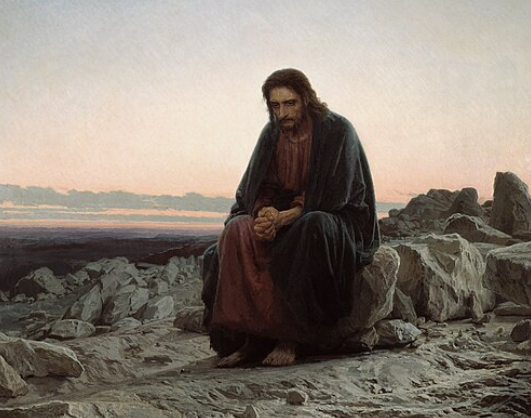
First, we find him tempted to use his divine power to turn stones into bread. And we might say with the Devil, “Go ahead Jesus. What’s wrong with eating when you’re hungry?” But physical hunger is not what’s at stake, is it? What is at stake is whether Jesus should go it alone or to live in perpetual remembrance of his need for God. If Jesus uses his power for self-gratification, where will that lead? Will it lead to the terrifying obedience of the Holy Cross? I don’t think so. Jesus does what Eve could not do: he remembers God and decides to accept his hunger rather than lose his relationship with the One he calls Father.
On our Lenten journey, will we pray for the strength to reject self-gratification so we can stay in love with God?
Secondly, we have the Devil tempting Jesus with the very word of God which Jesus recollects to pass the first test. It goes something like this: ‘Well, since you have God so much on the mind, why don’t you demand that God fulfill his promises and guarantee your safety? If you won’t take matters into your own hands,’ suggests the Devil, ‘then you’d better make sure God’s got your back!’ But in the culture created by Jesus, remembering God and testing God are two very different things. Remembering God quiets our hearts and minds in times of distress. Testing God, however, is another act of self-gratification, only more manipulative this time. To manipulate another person to satisfy ourselves is a form of abuse. Jesus won’t do it: there’s nothing abusive in his culture.
On our Lenten journey, will we pray for the strength to resist manipulating others to satisfy our own insecurities?
In a final attempt, the Devil plays on Jesus’ answer again, trying to trap Jesus in the almost universal human assumption that none of us are good enough as we are. Using Jesus’ humility against him, the Devil implies that Jesus will never really be enough for God and suggests that getting some power of his own would cheer him up. I mean, Jesus is the Jewish king, right? the Messiah and all that? But why stop with the throne of David? Judah is such a back-water little kingdom after all. Surely the Samaritans could do with a little whipping into shape, to say nothing of those Romans! But Satan has a short memory, forgetting that Jesus won’t trade anything for his love of God. And it’s love that saves Jesus here on this particular mountain top. Jesus side-steps the vision of power and focuses on the condition for obtaining it: prostrating himself before the Devil. Jesus will not take his love for God and give it to another.
On our Lenten journey, will we pray for the strength to give our love and faithfulness to those who are worthy of it, rather than those who seek to abuse and destroy?
The words, thoughts, and actions of Jesus create a culture. It’s a culture of right and wrong defined by self-less love. It’s a way of understanding the human relationship with God and one another that goes against the tide of self-gratification, manipulation, and misplaced loyalties in which we are all drowning. For any who have courage to journey with Jesus toward the Cross of Golgotha, this then is the Lenten task: to take our private desires, our dealings with others, and our politics and hold them up to the light of Jesus for examination. Some parts of our lives will pass that test; other parts will not.
Will we allow the culture of Christ’s self-emptying love to govern and change us?
Will we let him tell us what we should affirm and what we should reject?
Will we follow the command of the Heavenly Voice atop the real mountain of transfiguration and listen to Jesus?
Will we accept his judgment?
If we will, I expect we’ll find Jesus mighty to save. I expect we’ll find our own righteousness in his obedience. If we’ll follow Jesus, I expect the prophetic words of the Psalmist will prove true in our experience:
Happy are they whose transgressions are forgiven,
and whose sin is put away.
[1] Yuval Noah Harari. Sapiens: A Brief History of Humankind (Harper Perennial, 2015), p. 146.
[2] Ibid. p. 146-147.