4th Sunday after Epiphany
Micah 6:1-8
Psalm 15
1 Corinthians 1:18-31
Matthew 5:1-12
Collect
Almighty and everlasting God, you govern all things both in heaven and on earth: Mercifully hear the supplications of your people, and in our time grant us your peace; through Jesus Christ our Lord, who lives and reigns with you and the Holy Spirit, one God, for ever and ever. Amen.
Homily
I’ve already admitted in another sermon that the Gospel according to Luke is my favorite. Luke’s gospel is a brilliant piece of historical literature, filled with nuances, character development, all manner of detail, and important silences. But Luke’s gospel also transcends history in the way his words lead us by faith to The Truth of Living Word, which is unspeakable and timeless: a Truth which only the human heart can perceive as knowledge steps aside to welcome understanding. In a similar way, Matthew leads his audience through his text to the Living Word, but he differs from Luke in his method. Luke is a Greek historian. Matthew is a Jewish theologian. A brief comparison shows how striking this contrast is. Luke opens his gospel this way:
Since many have undertaken to compile a narrative about the events that have been fulfilled among us, just as they were handed on to us by those who from the beginning were eyewitnesses and servants of the word, I, too, decided, as one having a grasp of everything from the start, to write a well-ordered account for you…
Phew! That’s only the first half of the sentence! But Luke is an academic, a historian. Matthew’s account of the Gospel may be ordered, but that’s not at all his concern. Rather, what captures Matthew’s heart and mind is the epic tale of the People of Israel and their covenantal relationship with God. The Gospel according to Matthew emulates the narrative that spans the books of Exodus, Leviticus, Numbers, and Deuteronomy, the narrative which portrays the life of Moses. Here’s how Matthew’s gospel opens:
The book of the origins of Jesus the Messiah, the son of David, the son of Abraham.
Matthew’s intends to reveal three things about Jesus: that he is the Anointed One of God, and—as prerequisites—that he is in the royal family of King David, and that he is a Hebrew, an heir of the LORD’s covenant with Abraham. If Luke writes about the revelation of Jesus as the Christ to the Gentiles, Matthew writes about the lordship of Jesus as the Christ for the Jews. Matthew desires to show his people that Jesus is High Priest, High King, and Chief Prophet. And this desire shapes how Matthew tells his story.
In particular, the plotline of Jesus’ life in the opening chapters of Matthews gospel mirrors the plotline of the life of Moses. If you look at these two epic tales side by side, their similarities are obvious:
Moses is born into a situation where all male babies are being executed by a fearful king. Moses, however, is saved through the ingenuity of his mother and the good honest heart of Pharaoh’s daughter.
In Matthew’s gospel, Jesus is perceived as a threat by Herod, who seeks his life and kills all the male babies in Bethlehem. But Herod is duped by the ingenuity of Jesus’ father, Joseph, and the good honest hearts of the Wise Men, who “return to their home by another road.”
Moses remains out of sight for many years. Jesus remains out of sight for many years, but returns to Palestine after an exile in where? That’s right…Egypt!
The true greatness of Moses and his intimacy with God are revealed through water at the parting of the Red Sea. The true identity and greatness of Jesus are revealed through water at the Jordan River, where—only in Matthew’s gospel—we learn that the purpose of Jesus’ baptism is to fulfill the righteousness of the Law… the Law of who? That’s right: the Law of Moses!
After the water there is a time of peril and temptation in a desert. For Moses, it is 40 years. For Jesus it is 40 days.
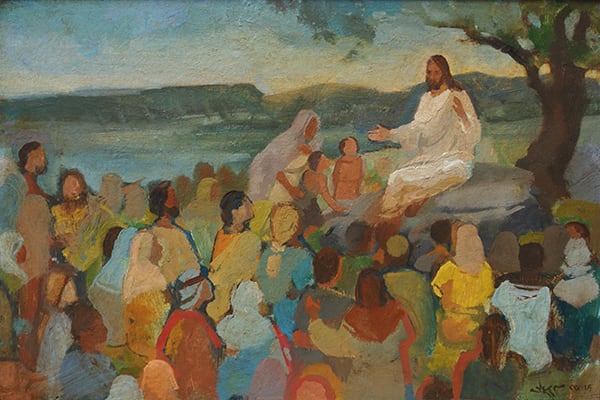
And this brings us to our story for today, in which Matthew portrays Jesus such a way that his audience would have had no doubt about Jesus’s status as the absolute Authority, the Lord of all. For you see, Moses goes up the mountain to receive the Law; Jesus goes up the mountain to give the law! Moses receives ten commandments, Jesus gives nine blessings followed by the commandment: rejoice and be glad!
Matthew writes his gospel in a way that makes the comparison between Moses and Jesus unavoidable. But the story of Jesus transcends the story of Moses, because Jesus is the LORD, whose ministry reveals to Israel that their high calling is to “go into all the world and teach all peoples” the Name and Love of the Sovereign and Almighty God. Jesus transcends Moses, because God took Moses from the Israelites, so that they had to appoint Joshua in his place. Jesus, on the other hand, is “with us always, even to the end of the age.”
So here we are today, nearly 2000 years removed from the time when Matthew sat down in the power of the Spirit with quill, ink, and papyrus scrolls to pen The Good News. But time means nothing to Matthew, for he desires all people in all times to know that Jesus of Nazareth—the Son of the Living God, the son of David, and the son of Abraham—is the Absolute Authority and Lord of all Creation. Matthew wants you to know this; Matthew wants me to know this.
If we take Matthew seriously, the absolute authority of Jesus will teach us how to interpret the Bible, the events of our personal lives, and the struggles of our world. With the lordship of Christ in mind, listen again to his teaching:
Blessed are the poor in spirit,
for theirs is the kingdom of heaven.
“Blessed are those who grieve,
for they will be comforted.
“Blessed are the meek,
for they will inherit the earth.
“Blessed are those who hunger and thirst for justice,
for they will be filled.
“Blessed are the merciful,
for they will receive mercy.
“Blessed are the pure in heart,
for they will see God.
“Blessed are the peacemakers,
for they will be called children of God.
“Blessed are those who are persecuted for the sake of righteousness,
for theirs is the kingdom of heaven.
“Blessed are you when people revile you and persecute you
and utter all kinds of evil against you falsely on my account.
“Rejoice and be glad, for your reward is great in heaven,
for in the same way they persecuted the prophets who were before you.”
Moses says, Thou shalt not… Jesus says, Blessed are you…
Both are talking about the same things: The love of God, and the love of neighbor.
In the way Matthew’s tells his story, we learn that Jesus personifies a God of affirmation, not condemnation.
+++
I’ll never forget my first day in seminary at Vanderbilt Divinity School. The class was simply called Hebrew Bible, and a world renowned expert on ancient Mesopotamian languages and literature, Dr. Jack Sasson, was our teacher. A physically small person, Dr. Sasson had an enormous presence: he spoke quietly but with shocking authority, often for long periods without reference to any notes. His intellect and experience were astounding, and every lecture was prophetic.
I’ll never forget that first day, though, when Dr. Sasson tucked his right hand under his left arm, placed a pondering left hand on his chin, looked up quizzically at the ceiling, and, to know one in particular, opened his lecture with these words: “You know… if 2 million people wandered around in an enclosed geographic area for 40 years, you’d think we’d have something to show for it. But there’s nothing in the Sinai Desert: Nothing!” A fulsome silence greeted this remarkable statement. Then, with hesitant deliberation, a hand went up.
“Yes?” Dr. Sasson invited the student.
“So… are you saying,” the student began, “that Moses didn’t exist?”
“No!” replied Dr. Sasson. “Clearly something happened, or we would have no story!”
“Then, what does it mean?” the student asked.
“It means…” replied our professor, now looking directly at us, “It means that you cannot understand the Bible if all you ask is, ‘What does it say?’ You must begin to ask, ‘How is the story told?’”
Another stunned silence ensued as we all pondered this. In so many words, Dr. Sasson had just argued that the Bible must be interpreted in order to be understood. This claim shocked all of us, because everyone of us divinity school students had grown up like every other Christian in America, assuming like our Founding Fathers that if something is true it must by definition be self-evident. The of course is the philosophical premise which grounds the opening argument of our Declaration of Independence. Dr. Sasson did not agree.
Born into a Jewish family in Aleppo, Syria, in 1941, and an immigrant to the United States in 1955 via Lebanon, Jack Sasson did not subscribe to the philosophical tenets of the American Enlightenment. And he had just luffed up his sails, put down his helm, rolled out his canon, timed his broadside to the rising swell of emotion, and blown a gaping hole in our preconceived notions. Several hands shot up into the air.
Over the next two weeks, Dr. Sasson led us through a short little book called The Art of Biblical Narrative by another esteemed scholar, Robert Alter. In his book, Alter demonstrates that only by examining and appreciating the artistry and narrative techniques of biblical literature can the student of scripture perceive the nuances of a story’s theological and moral significance.[1]
Today the artistry and narrative techniques of Matthew’s gospel point to a theology in which Jesus has no rival in heaven, or on earth, or under the earth. The moral significance of this is that Jesus cares far less about the content of our beliefs and far more about the quality of our love. Jesus never says, “Blessed are those who get all their doctrine correct, they will inherit a house with a golden key.” But what he does say is this: “Just as you did it to one of the least of these, you did it to me.”
The way we treat the poor, we treat the Lord.
The way we treat the stranger, we treat the Lord.
The way we treat our families, we treat the Lord.
The way we treat one another, we treat the Lord.
If we have claimed him in baptism as Lord of our lives, let us “stand by our oath,” as the Psalmist says, “even though it hurts.”
If we want to worship him, to “abide upon his holy hill,” let us do his justice, love his kindness, and walk humbly at his side.
Glory to the Holy and Undivided Trinity:
Creator, Living Word, and Spirit of Truth.
They look into our sin and see our need.
[1] See the Introduction and Chapter 1.