6th Sunday in Advent – A 7-week Advent
Year A Readings
Isaiah 35:1-10, Psalm 146:4-9, James 5:7-10
Matthew 11:2-11
Collect of the Saint’s Day (John of the Cross)
Judge eternal, throned in splendor, who gave John of the Cross strength of purpose and faith that sustained him even through the dark night of the soul: Shed your light on all who love you, in unity with Jesus Christ our Savior; who with you and the Holy Spirit lives and reigns, one God, for ever and ever. Amen.
Homily
In the Name of the Holy and Undivided Trinity:
One God, in glory everlasting. Amen.
It is clear to me now that my curiosity about the history of the Christian Tradition will be the subject of some life-long learning. The story of the Church has so many twists and turns, and the Gospel of Jesus Christ, along with the other scriptures, has resonated so differently with diverse cultures across time and space. There are some things, however, that we do know for certain. One of these is how there came to be a celebratory Mass during the middle of the penitential season of Advent. The season of Advent was originally a 40-day period of fasting and prayer in preparation for the Feast of the Nativity—the “Christ-mass.” But unlike Lent, which happens in the Spring of the Northern Hemisphere, Advent comes during the darkest, hungriest, most challenging time of year: a time of empty fields, empty bellies, and often empty hearts. It’s no surprise, then, that when he overhauled the liturgies for Advent, Pope Gregory the Great placed some light right in the middle of the darkness, The Introit St. Gregory chose for this joyful Mass comes from chapter 4 of Paul’s letter to the Philippians verses 4-6:
In the time St. Gregory was the Roman Pontiff—590 to 604 A.D.—the majority of people attending Mass wouldn’t have understood the Latin rendering of this text, but this is what they would have heard:
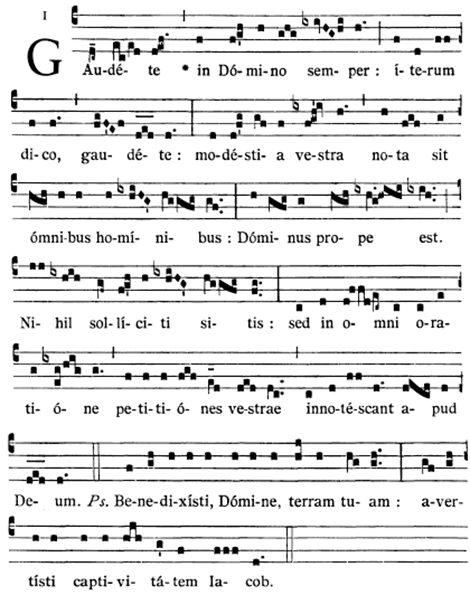
For fourteen-hundred years, the beauty of St. Gregory’s chant has caused people to blush with hope like a Christmas Rose, just as the spiritual urging of the Apostle Paul lightens our darkness with the assurance that “the Lord is near,” and we need “not worry about a thing.” This beauty and this assurance invite us into contemplation. So if you will, come with me now into the eternal silence that is the Womb of all being. Notice all the things in your life that you worry about, and I’ll notice mine. Then in the silence, let us together attempt to lay our worries down and wait with expectation…
Accept your body and put yourself lovingly at rest…
Breathe…
gentle lay down all your cares…
consent to the stillness…
accept yourself…
Know the presence of the Lord…
keep silence
Was it difficult to put down your worries? It was for me. I usually can’t get into deep quiet until I’ve been silent for about 10 or 15 minutes. But I worry that if I took that much time, I would be the only here when I opened my eyes!
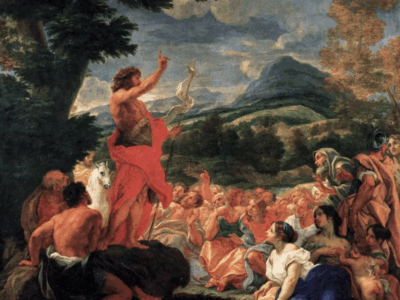
When I read today’s lesson from the Gospel, I can’t help imagining John the Baptist struggling with the same problem in prison: the problem of incessant and overbearing thoughts and emotions. I imagine that he had the opportunity in his incarceration, after all his preaching and prophesying, to enter into contemplation. But it seems that in the quiet, he was full of doubt and anxiety:
How could it have come to this?
Would Jesus not call down the powers of heaven to save him?
Was Jesus not the Messiah?
How worrying those questions must have been for someone who was so sure of Jesus in the beginning:
In the beginning John perceives the Living Word personified in Jesus and hails him with expectation and prophetic passion. But despite John’s certainty that Jesus is the Messiah, John is confused immediately by the humility of Jesus. John expected a Messiah with an axe and a winnowing fork. John expected what all Israel expected in the Messiah: a conquering hero, who would solve the political and economic struggles of Israel once and for all.
Imagine John in prison then, confused, afraid, dreading what his oppressors may do to him, and wondering why Jesus refuses to use his power to conquer… to literally set them free from the Romans and claim the material throne of David. With all the noise of his revival behind him, John has to reckon with the great silence of his secret heart, where he can no longer shout but only be,and he can’t figure out anymore who Jesus is. His doubt and anxiety are so counterintuitive to John that he can’t help himself and sends his students to talk with Jesus:
In his reply, Jesus invites John to consider that there’s more to him that the heir to a long-defunct royal house. Jesus gives John grace to contemplate something else in his long hours and days of solitude and deprivation. Into the spiritual poverty of his cousin, Jesus speaks good news. For what the Lord’s answer implies is that the coming of the Messiah is not merely for the temporal relief of Israel, though Jesus heals and feeds and frees everywhere he goes. Jesus wants John to look beyond the horizon of Israel’s dynastic pretensions to perceive that the Messiah comes to redeem the entire Creation, beleaguered by illness, hunger, fear, sin, and a stinging death. The Sacraments of this redemption are
- the blind, who glimpse for the first time the colors and the shapes of the world;
- the hobbled powerless beggars, rising to take up their mats and run;
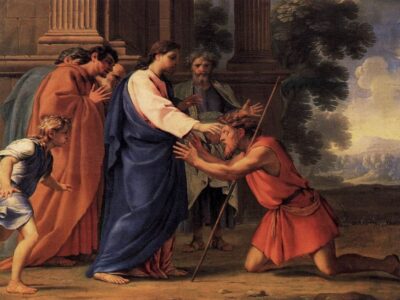
- the broken infected skin of the diseased, caressed and returned to its childlike luster;
- those who have never known music listening in astonishment to the voices of humans and birds, to the vibrations of harps and flutes,
- and the dead who breathe again… who pulse once more with the blessedness of everlasting love!
Far from being a strong-man, Jesus is quite disarming! And I wonder if, like John, this Jesus is different from the Messiah we want or expect or need. If we find ourselves taking offense at him like John, let me tell you the Good News, beloved in Christ: he will never turn us away when we voice our doubt or ask hard questions. Jesus will never dismiss our frustration as unreasonable, and he will never condemn us for wanting to have more knowledge than we can handle. Jesus will always respond to our need for assurance with the same compassion and love with which he responds to John: he will remind us of his true purpose and invite us to trust him completely. Time is not running out, you see, time is filling up. And when all the days of this world are accomplished—Aye! in the Fullness of Time—all will be explained, all will be made well, all the wounds of body, mind, and spirit will be soothed and healed, and death itself will pass away. And if, for a while, we walk through the dark night of the soul, may we cling to the truth: that while Mary and Joseph made their desperate way from door to door in Bethlehem, the Angelic Army was rehearsing a new song of Peace!
Perhaps we can imagine that John responded to his Lord and Savior by entering into a new but equally prophetic ministry, consenting to the same long-suffering patience that the Apostle James would come to know. And perhaps the spiritual consolation granted to John the Baptist by the Spirit was the ever expanding joy and certainty and love of the redeemed. Perhaps, in his captivity, the Spirit granted John the clear recollection of those same stories we’ve all heard: that, just when her labor made walking unbearable, Mary and Joseph found a clean dry place, and she bore a son whose light and beauty the darkness cannot comprehend, whose redeeming love the Herald Angels sing. As we turn our hearts toward the Banquet Feast of the Lamb, let us join them. For we too can sing a new song!
hued with darkling light,
Jesus came to earth as a little child:
Son of Man divine,
hope of Humankind,
Living Word and source of all creation.
You will sin unmake,
all our hearts unbreak,
you who are the meekest of the mild.
Savior at your name
hosts from Heaven came,
rank on rank, to sing of our salvation:
Alleluïyah!
Alleluïyah!
Rose of Jesse, long foretold, now blooming!
As of old we hymn,
thus, to echo them,
earth, and all the spheres, His advent tuning:
Sweet Emmanuel,
Sweet Emmanuel,
Christ the King all darkness now consuming!
Here at last I eat
at this Advent Feast,
born anew to life in His communion*
*from “Advent Communion” in The New Book and Other Theologies by Jonathan Bratt Carle