5th Sunday in Advent – A Seven-week Advent
Year A Readings
Isaiah 11:1-10
Psalm 72:1-7, 18-19
Romans 15:4-13
Matthew 3:1-12
Collect of the Day
Merciful God, who sent your messengers the prophets to preach repentance and prepare the way for our salvation: Give us grace to heed their warnings and forsake our sins, that we may greet with joy the coming of Jesus Christ our Redeemer; who lives and reigns with you and the Holy Spirit, one God, now and for ever. Amen.
Homily
In the Name of the One who was,
who is, and who is to come: the God of Jacob. Amen.
Occasionally my wife, Jessica, and I have a chance to sit down together and watch a show. Recently we’ve been working through the Netflix series Anne with an E, based on the novels by Lucy Maud Montgomery. The show is both poignant and hilarious, and one of the hilarious moments occurs when Anne imagines that she can dye her hair from its natural rust color to what she hopes will be a luscious black. Well… it turns out a shade of pale green, and Anne hides under her bed covers. Anne has to fess up to her adoptive mother, Marilla, who insists that the only thing to be done is to cut off Anne’s locks and begin re-growing her hair. Anne is mortified and heartbroken, but she realizes that Marilla is right and submits to the shears. The scene is so well written and so well acted that in the midst of Anne’s horror and Marilla’s pity a palpable hope is experienced by both that, in the end, Anne’s mistake can in fact be repaired. Amidst her tears, Anne accepts the comfort of her mother when Marilla says, “Come now, Anne, your hair with grow again.” It hurts to confess, and it hurts even worse to acknowledge and enter into the consequence of our action. But even in the midst of this hurt, the human heart shifts involuntarily and irresistibly to the contemplation of what might become possible in the wide-open vista beyond our mistakes and their consequences. Think of all the words that begin with the prefix R-E…
re-do re-pair re-grow re-make re-member re-fit repeat rehearse re-fill re-claim re-absorb re-acclimate re-tie re-charge re-acquaint re-act re-new re-adjust re-image re-apply
The list goes on and on. The strange thing about these words—even the ones where the R-E isn’t a prefix—is that they all have a positive connotation. All of these words imply a new chance to do something… or say something… or think or feel something in a manner that improves on what came before, or that re-stores what has become broken. These words are infused with hope.
At our clergy study group this past Wednesday, one colleague wondered if we might think this way about the word “re—pent.” Being a word nerd, I immediately thought to myself, “Hmm, if you can re-pent, what does it mean to pent?” I pent… you pent… he, she, it pents… ?? We’ll get to that in a moment…
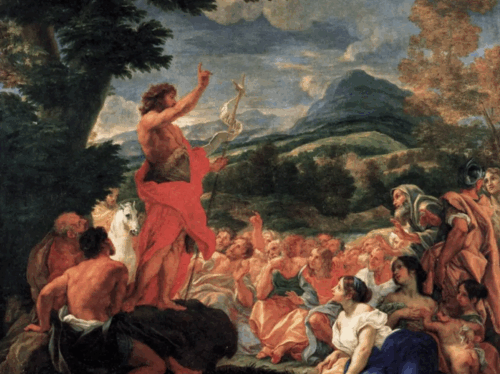
In our Gospel reading today, we find Saint John, the Baptizer, the prophet of the Most High, inviting his people to understand the ritual washing of baptism as the outward sign—which is to say the sacrament—of confession and repentance. This apparently strikes a chord in the hearts of the people, because folks from all walks of life flock to John down by the riverside. So of course the established religious leaders show up, perhaps out of curiosity, perhaps out of skepticism, perhaps out of jealousy, or maybe all of the above. Whatever their reasons, John doesn’t defer to these elite State-sponsored know-it-alls. Rather he takes them to task, calling them out for the ways they have lorded their institutional authority over the people while practicing nothing that they preach.
I can’t imagine they responded to John’s brimstone sermon very well. I think we can all admit that it’s one thing for circumstances to point out our faults and their consequences; but it’s quite another to be called to confession by another person, who inevitably is as deeply flawed as we are. Indeed, to be called to account by another person—especially in our culture—moves our hearts involuntarily and irresistibly to indignation and resentment. I don’t imagine those Pharisees and Sadducees were any different than us in this respect.
Thank goodness, then, that even though Jesus takes up the message of his older cousin John, “Repent for the kingdom of heaven has come near,” (Matthew 4:17) Jesus delivers this prophetic oracle in a different tone. Jesus calls people to confession and repentance even as he acknowledges them, heals them, feeds them, teaches them, and blesses them. In Jesus, the people of Galilee and Judea experience the call to confession as an invitation to join him in the new life made possible by his love. John says, “Bear fruit worthy of repentance… or get axed and thrown on the burn pile…” Jesus says, “Come to me, all you that are weary and are carrying heavy burdens, and I will give you rest. Take my yoke upon you, and learn from me; for I am gentle and humble in heart, and you will find rest for your souls. For my yoke is easy, and my burden is light.” (Matthew 11:28-30)
So if we can re-pent…. what does it mean to “pent”? What does it mean to live into the possibilities of Jesus’ loving invitation?
In his essential and timeless book The Undiscovered Self, renowned psychologist Carl Jung explores and brings to light “the true nature of the individual human being. […] Dr. Jung offers no easy solutions to the terrible crisis in world affairs. Instead he declares that the answer to world annihilation depends, not upon mass movements for good, nor on idealistic pleas for the prevalence of reason, but rather upon a recognition of the existence of good and evil in every individual, and a true understanding of the inner self.”[1] The heart of Jung’s argument is that religion, which is to say belief in a higher and ultimate power, gives an individual the ability to see beyond the brokenness of human life to a horizon where people—men and women and children—are no longer the slaves of either the State or the Corporations. Forgiving the gendered language of the 1950s, I invite you to receive the wisdom of one of our greatest thinkers. Dr. Jung writes:
In order to turn the individual into a function of the State, his dependence on anything beside the State must be taken from him.
But religion means dependence on and submission to the irrational facts of experience.
[And the facts of experience] do not refer directly to social and physical conditions; they concern far more the individual’s psychic attitude…
[The religions] build up a reserve…against the obvious and inevitable force of circumstances to which everyone is exposed…
The religions…teach another authority opposed to that of the “world.” […]
The individual who is not anchored in God can offer no resistance on his own resources to the physical and moral blandishments of the world. For this, he needs the evidence of inner, transcendent experience which alone can protect him from the otherwise inevitable [enslavement to the prevailing illusions of the State].[2]
If we put this together with Isaiah and John the Baptist, we can begin to say something about what kind of life is intended for the people of God who follow Jesus Christ!
Dr. Jung helps us understand that the life of Jesus must be the grounding principle of life for any who wish to follow him. For having seen the Word of the LORD, we in our generations are called to take up his ministry by the power of the Holy Spirit and stand firm against “the physical and moral blandishments of the world.” Experiencing the world through the wisdom and understanding of Christ Jesus, we see the arrogant pretenses of both State and Corporation for what they are: short-lived trivial things, whose allurements are the narcotic of the masses.
But the followers of Jesus are not impressed by anyone’s wealth: we understand the ultimate creative power of self-emptying love!
And the followers of Jesus are not impressed by anyone’s politics: we walk the Way of the Cross.
We who follow Christ are not drugged by the addictive opiates of prestige and legacy!
We who follow Christ know that all things… all things… came into being through him.
We know that perfection lies not behind us in some vague pastoral mythology with fruit trees and duplicitous serpents. No! We who follow Jesus know that perfection is eternally personified in the Crucified-Resurrected Son of God.
And having seen his glory—the glory as of the Father’s only Son, full of grace and truth—we are not cajoled by the false-promises of that which cannot save and those who have no power to redeem.
For unlike those whose ambition it is to sequester power and wealth within the agency of a few, Jesus Christ is a Sovereign who “judges the poor with righteousness” and “decides with equity for the meek of the earth.”
What does this mean for us, now, two-thousand years on?
For the followers of Jesus in our time and place, this means dismantling the State engineered caste systems of sex, class, race, national origin, and gender-identity, which deliberately ostracize persons to the margins of society, denying anyone outside State-established norms their full rights and sacred worth as human beings. But illumined by the justice and love of Jesus Christ we know that women are not less than… Poor people are not less than… People of color are not less than… Immigrants and Refugees are not less than… Transgendered people are not less than..
Following the Crucified-Resurrected King means raising a hue and cry against the Corporations who generate vast and unseemly profits through low worker wages and ecological neglect.
Becoming subject to Jesus means crying out from the rooftops that in this country you have to have money to get money, and that generations of wealth inequality between families with Pink skin and families with Black or Brown skin is evil.
Following Jesus means putting our feet down on the solid ground of Golgotha and holding firm as we point out the unavoidable similarities between the Cross and the Lynching Tree.
Following Jesus means standing in the power of his Name when we insist that no child should grow up in this country and not be taught in middle and high school about the Slave Trade and the Genocide of the Native Americans by Europeans.
All this is what it means to follow the Messiah.
This is what it means to be converted to the Way of Christ.
This is what it means to be born again, born of the Spirit, born from above.
Does anyone besides me feel a need and desire to confess and repent?
And what is Christianity in our time? What is the Church in our time? Looks a lot like a stump to me, hacked down to the ground by the wizards of the Prosperity Gospel and the State-sponsored religious politicians whose cruelty is their creed.
But if we here together will confess—even though it hurts and hurts worse to face the consequences— if we here can confess, maybe a branch will come out of the stump of the Church. If we can confess, maybe we can also experience hope. As one scholar, Stacey Duke, remarks as she reflects on Isaiah’s prophecy, “…transformation from a culture of fear to a world of peace begins with a stump. Out of something that appears finished, lifeless, left behind, comes the sign of new life—a green sprig. This is how hope gets its start—it emerges as a tiny tendril in an unexpected place.”[3]
Where are the places in your life that feel cut down, ruined, and powerless. Can you hear the Good News that “even now God might be nurturing the growth of something new and good from [your] old dead dreams?”[4] Look deep within your hearts: Can you see in Christ Jesus that the “Kingdom of Heaven has come near”? Maybe if we can, we will be able to come together in a moment and, with penitent hearts, confess our sins against God and our neighbor. If we can, if we will, I believe we will find rest for our souls and hope for this weary world. I we can, if we will: I believe we may yet bear fruit worthy of repentance.
Amen.
[1] Jung, Carl. The Undiscovered Self (Mentor Books, 1958), back cover.
[2] Ibid. pages 29-30 & 34.
[3] Stacey Simpson Duke, “Pastoral Perspective” in Feasting on the Word: Year A, Volume 1, Isaiah 11:1-10, p. 28.
[4] Ibid.